Alright, so I said I'd do this a few nights ago, but never got around to it. So here goes.
After all of the stress of loading up gear and then sitting in the parking lot for hours while Jim tried to get organized, we headed down to St. George. We camped on a wildlife preserve owned by BYU called Lytle Ranch. It was a nice little area with plently of trees and shady spots to camp, showers, and flush toilets. The only draw back was that Lytle Ranch was 45-50 minutes from our sites. So, every morning, we had to drive for quite a while to get to where we were going. Nothing like the convenience of Barnson's land.
Our work in Utah focused on the area of Land Hill, just outside of Ivins, Utah. The sites ranged in size and complexity form small storage features to large room blocks. The whole western face of Land Hill was covered in rock art. Molly and Jenny's crew were in charge of large scale excavations of roomblocks and storage features. My crew was more nomadic, tending to do re-record many of Gardner Daly's pre-recorded sites. In addition to re-recording, we dug test pits at many of these sites. Brad's crew was in charge of recording the rock art. That involved taking lots of photographs and placeing large sheets of Mylar over the panels and tracing over them with sharpies.
Jim's main research interests for Utah were to collect a high sherd yeild, understand the scale and quantitiy of sites on Land Hill, and to use this data to compare the data gathered in the AZ highlands.
I'll speak from personal experience, but our artifact yeild was significant. I got fairly good at choosing tet pit spots afte ther first few were a bust. Turns out, if you dig near or in midden, you get a lot more stuff than if you were to dig in or around a structure. The majority of our artifacts were ceramics. We had plenty of Dogozhi (sp?), Washington Black on White, Redware, corrugated and redwares.
The AZ part of fieldschool proved to be much more interesting (everything's better in AZ right?). We climbed up to an elevation of 6,500 feet. Which made temperatures much more tolerable. We camped at a BLM station in the middle of nowhere. The closest city was St.George, an hour away on a primitive road.
The sites were spectacular and relatively untouched. Brad and I worked on site A:10:24. This site had originally been recorded in 1988, and then later surface collected. As we got on site we were amazed at the high artifact densitiy. Immediately we found complete proj. points, shell beads, unworked olivella shells, lug handles, and painted sherds the size of the palm of your hand. The site was a sea of pin flags. The research strategy for AZ was slightly different. Jim was hesitant to excavate structures and preferred to do test pits and complete collection areas. Even with 10 people working on A:10:24, we still had too much to do. Jim wanted us to point plot all diagnostic and exotic artifacts on the surface (which really slowed us down). Field specimens collected from this site totalted in the 700s (and that was only two weeks of excavation). We also found a single piece of worked turquoise, a strangely worked and shaped scapula (mayan eccentric-esque), and the fragment of a human mandible, molars and pre-molars intact. Jim's strategy for dealing with the human remains was to simply stop digging and rebury it. The Hopi and Paiute agreed to that strategy, so we didn't have to notify anyone, inluding Joel's friends Rick and Rena... (if you don't get that one, I'll explain it)
After working on that site for two weeks my crew was put on survey. We didn't find much. Mostly lithic and ceramic scatters. Other survey crews found several large architectural sites with upright slabs, circular features, and high arifact densities.
All in all, it was a good field school. Jim was flustrered and stress at many times, especially after 9 flat tires, a run-in with a cow and one of our Yukons, and local crazies. It was obvious this was his first year. Joel had it down to a science, but Jim was way more flexible and open to suggestions. It was refereshing though to work with somone who felt that they could walk away from your site with the confidence that you were doing things the right way. That trust was refreshing and empowering. I feel like I could actually run an excavation now.
There is much more, including a visit to UNLVs excavation (sadly, Karen Harry isn't as colorful as Dave Madsen)(no funny stories), and the little funny stories about hitting the cow and other things.
Saturday, June 24, 2006

Thursday, June 22, 2006
Friday, June 16, 2006
Fremont Symposium
Cady and I were talking the other day, and it occurred to me that we should have a one-shot Fremont Symposium at BYU. I'm picturing like less than 30 people.
One day would be papers from each participant on whatever Fremont topic they wanted.
The next day or 2 could be set aside for open discussion of topics. You could submit a topic and a bibliography and people could come in and talk about it openly. Wouldn't it be cool to be able to have a 30 minute round-table discussion on whatever you wanted? Why don't we find Fremont whole vessels? Where are all the burials? What the H is a central structure? The list goes on...
People to attend in addition to the FoF:
Joel
Rich
Lane
Jim A.
Margaret Lyneis
Phil Geib
Shane Baker
Byron Loosle
Charmaine Thompson
Matheney?
Glenna
Kenny Winch
Alan Reed
SHPO/State Archaeologist People
Renee Barlow
Duncan Metcalf
Steve Simms
Dave Madsen
Andrew Ugan
Jason Bright
Interested U of U students
Karen Harry
The new Fremont Indian State Park archaeologist
Any other interested Great Basin Archaeological All-stars (Mel Aikens, the Fowlers, Gardener Dalley, McFadden)
Other Government people
Marti Allen?
The SUU Lady (name escapes me)
Etc...
Special Guest Star: V. Garth Norman
I know Ray tried to do this once with Anasazi pottery and nobody showed up, so we'd have to be a little careful. I'd also like to leave subsistence out of things as much as possible. We don't need to bring up all the old arguments, the point of this would be to press ahead.
One day would be papers from each participant on whatever Fremont topic they wanted.
The next day or 2 could be set aside for open discussion of topics. You could submit a topic and a bibliography and people could come in and talk about it openly. Wouldn't it be cool to be able to have a 30 minute round-table discussion on whatever you wanted? Why don't we find Fremont whole vessels? Where are all the burials? What the H is a central structure? The list goes on...
People to attend in addition to the FoF:
Joel
Rich
Lane
Jim A.
Margaret Lyneis
Phil Geib
Shane Baker
Byron Loosle
Charmaine Thompson
Matheney?
Glenna
Kenny Winch
Alan Reed
SHPO/State Archaeologist People
Renee Barlow
Duncan Metcalf
Steve Simms
Dave Madsen
Andrew Ugan
Jason Bright
Interested U of U students
Karen Harry
The new Fremont Indian State Park archaeologist
Any other interested Great Basin Archaeological All-stars (Mel Aikens, the Fowlers, Gardener Dalley, McFadden)
Other Government people
Marti Allen?
The SUU Lady (name escapes me)
Etc...
Special Guest Star: V. Garth Norman
I know Ray tried to do this once with Anasazi pottery and nobody showed up, so we'd have to be a little careful. I'd also like to leave subsistence out of things as much as possible. We don't need to bring up all the old arguments, the point of this would be to press ahead.
Thursday, June 15, 2006
ASU = BYU South?
The following is an excerpt of an angry email from Dr. Mary Rothschild, a long-term professor of history and former chair of Womens' Studies. She is part of a vocal cadre of faculty who are extremely opposed to the policies of ASU's President, Michael Crow.
"And I know I shouldn't say this, but many of us hate that we are becoming BYU South. The Fulton fundraising does not come without strings. You should see the flyer that is in the box outside the fence where the new enormous LDS Institute is being built. It is an article from the Church News that has quotes from the president saying that ASU is particularly glad to have Mormons because they raise the retention rates and are such good students, etc. Honestly, and we are put on public notice in the Wall Street Journal for not hiring a professor of religious studies because the local church objects. It takes me back to my first graduation here when Homer Durham returned to be the public speaker and he began with a prayer and I walked out. I think there should be a WALL between religious groups and public universities. Campus ministries are fine, but they exist for students and should be nothing more than extracurricular activities."
I guess I know now why I got into ASU huh!?
Note: Homer Durham is my great-uncle.
"And I know I shouldn't say this, but many of us hate that we are becoming BYU South. The Fulton fundraising does not come without strings. You should see the flyer that is in the box outside the fence where the new enormous LDS Institute is being built. It is an article from the Church News that has quotes from the president saying that ASU is particularly glad to have Mormons because they raise the retention rates and are such good students, etc. Honestly, and we are put on public notice in the Wall Street Journal for not hiring a professor of religious studies because the local church objects. It takes me back to my first graduation here when Homer Durham returned to be the public speaker and he began with a prayer and I walked out. I think there should be a WALL between religious groups and public universities. Campus ministries are fine, but they exist for students and should be nothing more than extracurricular activities."
I guess I know now why I got into ASU huh!?
Note: Homer Durham is my great-uncle.
Tuesday, June 06, 2006
Doug McFadden Update
This morning I was perusing the Arizona State Museum list of permit holders, and noticed that McFadden had started his own contract company out of Kanab.
http://www.statemuseum.arizona.edu/profsvcs/permits/permittees.shtml
Note also that Sean's company out of Layton, UT is also on this list.
http://www.statemuseum.arizona.edu/profsvcs/permits/permittees.shtml
Note also that Sean's company out of Layton, UT is also on this list.
Wednesday, May 31, 2006
Searcy SIR - Spring 2006
After a year at OU, I feel a little closer to the end. Overall, I've been enjoying myself and the work here. Classes went well this semester. I took two, one was a directed readings of Southwest archaeology under Paul Minnis and the other was my core class for biological anthropological theory.
Southwest Readings
Paul drilled me good with this one, requiring me to read about 2 books a week at the beginning of the semester, then he tapered off at the end. The last part of my semester was dedicated to writing a paper that would be part of my dissertation prospectus and likely part of a future NSF dissertation improvement grant. Best books of the semester - "Exploring the Hohokam" (edited volume) and "Ceramics and Ideology" (Patricia Crown). Least impressive book of the semester - "Becoming Aztlan" (Carol Riley) - this last one came out last year and talks of how southwestern cultures were where Aztec ancestors originated. He kind of jumped around from weak evidence to weaker evidence.
Theories of Biological Anthropology
This is the required course for all grad students here at OU. The instructor is really great and knows a lot about the history of physical anthropology. I really enjoyed getting a better grasp on evolutionary issues and attempting to understand the taxonomy of early man. I still don't know if I believe that the Neanderthals were a different species from homo sapiens because I know a number of people with distinct crested brows. This may prove the theory that early homo sapiens moved north into Europe and were hooking up with the Neanderthals of that area. Great book from this class/fun read - "Race is a Four-Letter Word" (Brace) - this book looks at how the concept of race is a socially constructed phenomenon.
Other activities
The Spring semester also brought a close to the rewriting of my thesis for publication. Dr. Clark is in the process of editing it as we speak, pouring buckets of blood over the pages, so that it can be published. Clark originally offered to publish it in the NWAF Papers series, but said that if it is good enough, he will take it to some university presses (Texas, Oklahoma, Utah, etc.) to try and get it picked up. We'll see what happens.
Also, I was able to put together a paper for the SAAs in Puerto Rico in April, co-writing it with a friend from ASU (Jamie Holthyusen). It highlighted my ethnographic research of metates in guatemala and applied those findings to a collection of metates excavated from La Quemada, Mexico. I haven't heard a report of how the session went, but hopefully someone may have decided to listen to the session rather than lounge on the beach. I know what I would have been doing.
Otherwise, I have been working a lot on a full-length documentary dealing with illegal immigration, a real hot topic right now. We have a lot of footage of the recent rallies here in OKC and in Dallas. We also have had a number of interviews with state representatives and will be filming in Mexico and at the border after my dig at Casas Grandes in July. I also just started work on a Q'eqchi'-English dictionary with a student from SUNY Albany and that seems to be rolling along. The semesters never end. Take care all.
Southwest Readings
Paul drilled me good with this one, requiring me to read about 2 books a week at the beginning of the semester, then he tapered off at the end. The last part of my semester was dedicated to writing a paper that would be part of my dissertation prospectus and likely part of a future NSF dissertation improvement grant. Best books of the semester - "Exploring the Hohokam" (edited volume) and "Ceramics and Ideology" (Patricia Crown). Least impressive book of the semester - "Becoming Aztlan" (Carol Riley) - this last one came out last year and talks of how southwestern cultures were where Aztec ancestors originated. He kind of jumped around from weak evidence to weaker evidence.
Theories of Biological Anthropology
This is the required course for all grad students here at OU. The instructor is really great and knows a lot about the history of physical anthropology. I really enjoyed getting a better grasp on evolutionary issues and attempting to understand the taxonomy of early man. I still don't know if I believe that the Neanderthals were a different species from homo sapiens because I know a number of people with distinct crested brows. This may prove the theory that early homo sapiens moved north into Europe and were hooking up with the Neanderthals of that area. Great book from this class/fun read - "Race is a Four-Letter Word" (Brace) - this book looks at how the concept of race is a socially constructed phenomenon.
Other activities
The Spring semester also brought a close to the rewriting of my thesis for publication. Dr. Clark is in the process of editing it as we speak, pouring buckets of blood over the pages, so that it can be published. Clark originally offered to publish it in the NWAF Papers series, but said that if it is good enough, he will take it to some university presses (Texas, Oklahoma, Utah, etc.) to try and get it picked up. We'll see what happens.
Also, I was able to put together a paper for the SAAs in Puerto Rico in April, co-writing it with a friend from ASU (Jamie Holthyusen). It highlighted my ethnographic research of metates in guatemala and applied those findings to a collection of metates excavated from La Quemada, Mexico. I haven't heard a report of how the session went, but hopefully someone may have decided to listen to the session rather than lounge on the beach. I know what I would have been doing.
Otherwise, I have been working a lot on a full-length documentary dealing with illegal immigration, a real hot topic right now. We have a lot of footage of the recent rallies here in OKC and in Dallas. We also have had a number of interviews with state representatives and will be filming in Mexico and at the border after my dig at Casas Grandes in July. I also just started work on a Q'eqchi'-English dictionary with a student from SUNY Albany and that seems to be rolling along. The semesters never end. Take care all.
Tuesday, May 30, 2006
Watkins SIR Spring 2006
Two classes for me this term, both of which are only tangentially related to Archaeology.
Agent-based Modeling in the Social Sciences
What is agent-based modeling you may ask? At the end of an entire semester, you'd think that I'd be able to answer that question. Tragically, I'm not sure that I'm going to be able to do that.
It may be best to begin with an example. Have you ever wondered how they do those epidemic disease predictions? You know on the news when they say, "If the Bird Flu broke out in Hong Kong, 10,000 people would be infected in the first 6 hours, Tokyo and Beijing would be hit within the first 12 hours, yada yada yada..." Well, these predictions are made with agent-based modeling. They basically program a bunch of little people, aka agents, and let them walk around a city. They program stuff like infection rates and the proximity of infection and then watch what happens. They run it like 1,000 times and then interpret the results.
We were supposedly trying to apply this technique to problems in the social sciences. Good luck. This is simply the newest fad in archaeology. Most of the models are based on so-called prisoner's dilemma exchanges, where agents are assumed to be selfish. I could get into a lot of reasons why ABM is problematic, but it just makes me remember the horror of last semester.
Archaeometry
This class was really cool. I worked with turquoise, a geological sample from Kingman, AZ and a bead Joel and Cady loaned me from the Parowan Valley. We learned a materials science approach to analysis, where you characterize the texture (surface characteristics), structure (phases), and composition (elemental makeup) of a substance. Identifying texture is done primarily with scanning electron microscopes. There are a variety of techniques available to determine elemental composition (INAA, PIXE, Electron Microprobe, ICP-MS, etc). These sort of data are most often used in provenance studies. What is a phase you ask? This is kind of a tough question. I think it's best explained with an example. If you sent a piece of chert through a compositional analysis, the results would be mostly silicon with traces of whatever else is in the material (i.e., Ti, Fe, Ca, whatever). Running the same sample through a structural analysis would identify it as chert. Essentially, instead is identifying elements, compositional analysis identifies minerals and various molecules.
Anyway, these folks believe that to do an analysis right, you need to address texture, structure, and composition. There are a lot of advantages to this approach, and if you have the $$ and the means, I would highly recommend it.
Other News
Knowing what Mike and Dave are currently going through, I feel a little guilty mentioning this, but it is going to come out in the end. My dissertation has just been funded by the NSF, through no effort on my part. At the beginning of the semester, I was attached to an NSF proposal submitted by my advisor, Dave Abbott, and some other ASU faculty. A few weeks ago, we learned it had been funded, and I'm going to be paid for 2 years to work on the project. We'll be investigating the Southern Sinagua (the so-called Verde Confederacy consisting of the pueblo sites along the Verde River, like Tuzigoot, Montezuma's Castle, etc), and my part of it is going to be creating a ceramic typology, chronology, and a mechanism for sourcing the pottery. I think that it's going to be kind of a big deal, we're essentially taking a culture from 0-60 in a few short years. Anyway, I'm pretty excited about it, while at the same time, I ackowledge that I have fallen into this without really doing anything much to particularly earn it.
Hope to see some other SIRs soon. I feel bad that mine was late too.
Agent-based Modeling in the Social Sciences
What is agent-based modeling you may ask? At the end of an entire semester, you'd think that I'd be able to answer that question. Tragically, I'm not sure that I'm going to be able to do that.
It may be best to begin with an example. Have you ever wondered how they do those epidemic disease predictions? You know on the news when they say, "If the Bird Flu broke out in Hong Kong, 10,000 people would be infected in the first 6 hours, Tokyo and Beijing would be hit within the first 12 hours, yada yada yada..." Well, these predictions are made with agent-based modeling. They basically program a bunch of little people, aka agents, and let them walk around a city. They program stuff like infection rates and the proximity of infection and then watch what happens. They run it like 1,000 times and then interpret the results.
We were supposedly trying to apply this technique to problems in the social sciences. Good luck. This is simply the newest fad in archaeology. Most of the models are based on so-called prisoner's dilemma exchanges, where agents are assumed to be selfish. I could get into a lot of reasons why ABM is problematic, but it just makes me remember the horror of last semester.
Archaeometry
This class was really cool. I worked with turquoise, a geological sample from Kingman, AZ and a bead Joel and Cady loaned me from the Parowan Valley. We learned a materials science approach to analysis, where you characterize the texture (surface characteristics), structure (phases), and composition (elemental makeup) of a substance. Identifying texture is done primarily with scanning electron microscopes. There are a variety of techniques available to determine elemental composition (INAA, PIXE, Electron Microprobe, ICP-MS, etc). These sort of data are most often used in provenance studies. What is a phase you ask? This is kind of a tough question. I think it's best explained with an example. If you sent a piece of chert through a compositional analysis, the results would be mostly silicon with traces of whatever else is in the material (i.e., Ti, Fe, Ca, whatever). Running the same sample through a structural analysis would identify it as chert. Essentially, instead is identifying elements, compositional analysis identifies minerals and various molecules.
Anyway, these folks believe that to do an analysis right, you need to address texture, structure, and composition. There are a lot of advantages to this approach, and if you have the $$ and the means, I would highly recommend it.
Other News
Knowing what Mike and Dave are currently going through, I feel a little guilty mentioning this, but it is going to come out in the end. My dissertation has just been funded by the NSF, through no effort on my part. At the beginning of the semester, I was attached to an NSF proposal submitted by my advisor, Dave Abbott, and some other ASU faculty. A few weeks ago, we learned it had been funded, and I'm going to be paid for 2 years to work on the project. We'll be investigating the Southern Sinagua (the so-called Verde Confederacy consisting of the pueblo sites along the Verde River, like Tuzigoot, Montezuma's Castle, etc), and my part of it is going to be creating a ceramic typology, chronology, and a mechanism for sourcing the pottery. I think that it's going to be kind of a big deal, we're essentially taking a culture from 0-60 in a few short years. Anyway, I'm pretty excited about it, while at the same time, I ackowledge that I have fallen into this without really doing anything much to particularly earn it.
Hope to see some other SIRs soon. I feel bad that mine was late too.
NSF Avoidance and Burial Excavation
I am currently in the middle of re-writing my NSF dissertation improvement grant. Not fun. It's taking me for freaking ever and I just can't seem to get it done. So to avoid having to stare at it some more I'll do a quick recount of my excavation of a burial two weeks ago.
Some kids found a burial out at a teen party spot, under some rocks in a little overhang on a rock outcrop. The sheriff didn't know if it was historic/prehistoric, native american/or whitee. So he called a forensic anthropologist here at UNLV. Since all the archaeology professors were out on business, the forensic anthropologist took me and a couple of her students along. Long story short, I got to excavate the burial. It still had some flesh on different parts of the bones (although it was leather hard or even brittle in some places). Anyway, it was an interesting morning and nice to get out of the office. So that's my story...sadly it was short and now I have to go back to the NSF. For those of you out at Jim Allison's fieldschoo, I think I'll be coming to visit June 14 or 15 or somewhere around then. Are there any tents with only one guy in them, or should I bring my own tent?
Some kids found a burial out at a teen party spot, under some rocks in a little overhang on a rock outcrop. The sheriff didn't know if it was historic/prehistoric, native american/or whitee. So he called a forensic anthropologist here at UNLV. Since all the archaeology professors were out on business, the forensic anthropologist took me and a couple of her students along. Long story short, I got to excavate the burial. It still had some flesh on different parts of the bones (although it was leather hard or even brittle in some places). Anyway, it was an interesting morning and nice to get out of the office. So that's my story...sadly it was short and now I have to go back to the NSF. For those of you out at Jim Allison's fieldschoo, I think I'll be coming to visit June 14 or 15 or somewhere around then. Are there any tents with only one guy in them, or should I bring my own tent?
Saturday, May 13, 2006
Possible Thesis Topic
On the way back to Provo, I had a Yoder-esque epiphany (remember the M.A.N. in the Van moment Dave?)
I'd like to do something of a border study between the Parowan Valley (Fremont) and the St. George Basin (Virgin Anasazi). In other words, looking at differences and similarities between the Fremont and the Anasazi.
It is obvious we have a ecological and cultural border, it would be interesting to chart many of the cultural differences and similarities.
I could do this in several ways:
First, toolstone preferences. North of the St. George Basin (in the Parowan Valley) we see a preference for obsidian and PBN points (made of obsidian). In the St.GB we see the PBN point style but they are all made of chert. This difference is also evident in debitage from various sites.
Second, ceramic design styles and distribution. Are pots coming from north of the St. GB or east of the St. GB?
I think that it would be intersting to see how the borders really affect cultural styles/diagnostics/etc. In many ethnographies we see that border differences are much stronger, but in some we see that border cultures are muddled and blurry (Hodder 1982).
Anyway, it's all very preliminary and sketchy, but I'd like to look at the possibilities that a topic like this could bring. I'd appreciate any criticism (with the realization that it's all very general and was devised today) . I probably won't get to many of your comments for a little while (internet access is difficult right now).
I'd like to do something of a border study between the Parowan Valley (Fremont) and the St. George Basin (Virgin Anasazi). In other words, looking at differences and similarities between the Fremont and the Anasazi.
It is obvious we have a ecological and cultural border, it would be interesting to chart many of the cultural differences and similarities.
I could do this in several ways:
First, toolstone preferences. North of the St. George Basin (in the Parowan Valley) we see a preference for obsidian and PBN points (made of obsidian). In the St.GB we see the PBN point style but they are all made of chert. This difference is also evident in debitage from various sites.
Second, ceramic design styles and distribution. Are pots coming from north of the St. GB or east of the St. GB?
I think that it would be intersting to see how the borders really affect cultural styles/diagnostics/etc. In many ethnographies we see that border differences are much stronger, but in some we see that border cultures are muddled and blurry (Hodder 1982).
Anyway, it's all very preliminary and sketchy, but I'd like to look at the possibilities that a topic like this could bring. I'd appreciate any criticism (with the realization that it's all very general and was devised today) . I probably won't get to many of your comments for a little while (internet access is difficult right now).
Greetings from the Middle of Nowhere
Hey everyone,
I'm up for the weekend from the 2006 fieldschool.
Things down there are good, but incredibly hot.
The project is divided into four areas situated near Land Hill, just outside of Ivins, Utah. Here's a brief summary of the activities going on down there.
Molly's crew is doing a full scale excavation of a large PII or PIII site (I think it's a small community site). They are just getting started with excavation after two weeks of surface collection and mapping.
Jenny's crew is doing something similar to Molly's. They are currently chasing a wall. I don't know much more than that.
Brad's crew is recording or re-recording all of the rock art on Land Hill. In the process of recording the rock art, they have discovered two rock shelters among the boulders.
My crew is currently re-recording all of Gardner Dalley and Doug McFadden's recorded sites. We have tested one PIII site and several rock art sites. We have been doing something interesting with rock art recording. We have taken large sheets of mylar, placed them on the rock art panels and then traced over the rock art with sharpie markers. In this way, we have been able to get full scale representations of the rock art. When we get back, we hope to scan them. It really beats using a tape measure and feature sketch form.
Brad's crew has yet to use this method, but I am pretty impressed. On Tuesday, my crew will test a PIII site with a lot of redware polychrome sherds and white on black sherds. There is also a moderate amount of obsidian debitage.
I really don't know much more about the other crews or their activities since my crew is much more mobile and more survey/testing oriented.
I'm up for the weekend from the 2006 fieldschool.
Things down there are good, but incredibly hot.
The project is divided into four areas situated near Land Hill, just outside of Ivins, Utah. Here's a brief summary of the activities going on down there.
Molly's crew is doing a full scale excavation of a large PII or PIII site (I think it's a small community site). They are just getting started with excavation after two weeks of surface collection and mapping.
Jenny's crew is doing something similar to Molly's. They are currently chasing a wall. I don't know much more than that.
Brad's crew is recording or re-recording all of the rock art on Land Hill. In the process of recording the rock art, they have discovered two rock shelters among the boulders.
My crew is currently re-recording all of Gardner Dalley and Doug McFadden's recorded sites. We have tested one PIII site and several rock art sites. We have been doing something interesting with rock art recording. We have taken large sheets of mylar, placed them on the rock art panels and then traced over the rock art with sharpie markers. In this way, we have been able to get full scale representations of the rock art. When we get back, we hope to scan them. It really beats using a tape measure and feature sketch form.
Brad's crew has yet to use this method, but I am pretty impressed. On Tuesday, my crew will test a PIII site with a lot of redware polychrome sherds and white on black sherds. There is also a moderate amount of obsidian debitage.
I really don't know much more about the other crews or their activities since my crew is much more mobile and more survey/testing oriented.
Friday, May 05, 2006
Travel Discount
Well summer is here, at least in Vegas anyway! It is already heating up in the city from hell. We refuse to turn our air conditioner on any earlier than we have to .. last night our house registered 88 degrees inside but we will not give in! Electricity is too expensive so we're going to hold out even if it means we no longer wear clothes inside.
On a lighter note, while most of you will be doing thesis/doctorate work, I thought I'd let you all in on a chance to save some money if you will be traveling with your families. My husband became a travel agent a month ago and we now receive discount travel. We are going to San Diego in July and will get into Sea World, San Diego Zoo, and the Wild Animal Park all at 50% off as well as 30%-50% off our hotel. If you are traveling at all this summer, email me before you make your reservations and I'll can let you know how to save some money; with gas prices escalating quickly, every little bit counts.
Sorry this isn't "archaeology" related but so many of us are married and have little ones that discounts on travel come in very handy and I thought I'd share.
On a lighter note, while most of you will be doing thesis/doctorate work, I thought I'd let you all in on a chance to save some money if you will be traveling with your families. My husband became a travel agent a month ago and we now receive discount travel. We are going to San Diego in July and will get into Sea World, San Diego Zoo, and the Wild Animal Park all at 50% off as well as 30%-50% off our hotel. If you are traveling at all this summer, email me before you make your reservations and I'll can let you know how to save some money; with gas prices escalating quickly, every little bit counts.
Sorry this isn't "archaeology" related but so many of us are married and have little ones that discounts on travel come in very handy and I thought I'd share.
Thursday, May 04, 2006
Mr. Yoder's Semester In Review 2006a
Schools not over for another week, but I'm sick of working on my papers.
Three classes again this semester. Need to get out of school man. Chris and Mike, do you realize how much we are going to be in debt by the time we're finished. I try not to think about it. Anyway......here we go.
Origins of Agriculture: In this class we talked about….the origins of agriculture. We spent a large amount of time talking about the near east. Understandable, since this was where agriculture started, but disappointing in some ways. Although we did discuss the New World, it took a back seat (like the VERY back of the bus type seat) to the near east. We also didn’t talk much about the spread of agriculture to non-agriculturalists, hunter gather/farmer relations, or the impacts and direct effects of agriculture, which is what I find most interesting. We did discuss this stuff, but only lightly. On the positive side we read lots of classic articles by the likes of Braidwood, Bar-Yosef, Binford, Flannery, Smith, and the like. One of the most interesting was by Rindos. Check out Rindos 1980 for an interesting symbiotic view of things. Who freaking needs culture, we have evolution! (Just kidding, it really is a good article)
Rindos, David
1980 Symbiosis, Instability, and the Origins and Spread of Agriculture: A New Model. Current Anthropology 21:751-772.
Some of the main questions at the beginning of the class were why, how, when, and under what conditions was agriculture adopted. The conclusion…..who freaking knows. It’s not quite that bad, but a lot of very intelligent people disagree on most of these issues. Why was agriculture adopted? I think the current trend is to say for a lot of reasons and be kinda wishy washee. True, lots of things came into play, but grow a pair and state what you think THE prime mover was.
Ceramic Analysis: Basically a review of ceramics, including physical analysis and theory. I was disappointed in this class because it was taught with senior level undergrads and so was, well, pretty basic. I did get the chance to do some analysis on a ceramic collection from a Virgin Anasazi site which has gotten me interested in the Virgin Anasazi in general. Pretty cool group. They’ve kinda been forgotten by the Southwesterners, just like the Fremont. They’re kinda like brothers the Fremont and Virgin Anasazi are….bastard brothers….bastard brothers with the same southwestern mom but different fathers. Yeah. There’s an article title in there somewhere, “The Fremont and Virgin Anasazi: Bastard Sons of the Southwest”
Curation Issues: In this class we discussed how important curation and public anthropology are. Reinforced the necessity of the YAR, as well as provided me with the chance to do some research for an article I’ve been wanting to write. I sent out surveys to professors all over the U.S. asking about their students and how many were doing theses or dissertations on curated materials vs. new materials. I’m hoping to write this up this summer. Sent it out to around 100 professors, got responses from roughly 60. How many had bad things to say, only 2. Who were they? One was an academic god of agriculture, the other was our very own Juan. I was soooo not surprised.
On top of classes I did some survey work for one of my professors for some money on the side. I then had to write up the report for the BLM. I was also writing the archaeology chapter for that multidisciplinary project out at Walking Box Ranch. Every other weekend I was in the field helping run the field school. We excavated parts of a rockshelter over in the Mojave Desert, in Cali. I wrote a ton of grants, including the big nasty NSF. But much of that has paid off, as I scored some money for North Creek. I also spent some time doing some more sandal analysis as well as getting the Antelope Cave collection X-rayed. I got some really cool images and will hopefully be finishing that article this summer. All in all I was way to busy and figured about half way through the semester I had bit off more than I could chew. By then I was screwed and just had to stop sleeping to pull it all off.
But now summer is here! I’m going to be spending the first couple of weeks finishing up the sandal article, rewriting my NSF, and writing the curation article. Then I’m going to go visit Jim Allison’s and Karen Harry’s field schools, both up on the Shivwits, and dig me some Virgin Anasazi sites! August is digging at North Creek with Dr. J, where we hope to excavate the entire Early Holocene pithouse. Can’t wait to be in the field.
Three classes again this semester. Need to get out of school man. Chris and Mike, do you realize how much we are going to be in debt by the time we're finished. I try not to think about it. Anyway......here we go.
Origins of Agriculture: In this class we talked about….the origins of agriculture. We spent a large amount of time talking about the near east. Understandable, since this was where agriculture started, but disappointing in some ways. Although we did discuss the New World, it took a back seat (like the VERY back of the bus type seat) to the near east. We also didn’t talk much about the spread of agriculture to non-agriculturalists, hunter gather/farmer relations, or the impacts and direct effects of agriculture, which is what I find most interesting. We did discuss this stuff, but only lightly. On the positive side we read lots of classic articles by the likes of Braidwood, Bar-Yosef, Binford, Flannery, Smith, and the like. One of the most interesting was by Rindos. Check out Rindos 1980 for an interesting symbiotic view of things. Who freaking needs culture, we have evolution! (Just kidding, it really is a good article)
Rindos, David
1980 Symbiosis, Instability, and the Origins and Spread of Agriculture: A New Model. Current Anthropology 21:751-772.
Some of the main questions at the beginning of the class were why, how, when, and under what conditions was agriculture adopted. The conclusion…..who freaking knows. It’s not quite that bad, but a lot of very intelligent people disagree on most of these issues. Why was agriculture adopted? I think the current trend is to say for a lot of reasons and be kinda wishy washee. True, lots of things came into play, but grow a pair and state what you think THE prime mover was.
Ceramic Analysis: Basically a review of ceramics, including physical analysis and theory. I was disappointed in this class because it was taught with senior level undergrads and so was, well, pretty basic. I did get the chance to do some analysis on a ceramic collection from a Virgin Anasazi site which has gotten me interested in the Virgin Anasazi in general. Pretty cool group. They’ve kinda been forgotten by the Southwesterners, just like the Fremont. They’re kinda like brothers the Fremont and Virgin Anasazi are….bastard brothers….bastard brothers with the same southwestern mom but different fathers. Yeah. There’s an article title in there somewhere, “The Fremont and Virgin Anasazi: Bastard Sons of the Southwest”
Curation Issues: In this class we discussed how important curation and public anthropology are. Reinforced the necessity of the YAR, as well as provided me with the chance to do some research for an article I’ve been wanting to write. I sent out surveys to professors all over the U.S. asking about their students and how many were doing theses or dissertations on curated materials vs. new materials. I’m hoping to write this up this summer. Sent it out to around 100 professors, got responses from roughly 60. How many had bad things to say, only 2. Who were they? One was an academic god of agriculture, the other was our very own Juan. I was soooo not surprised.
On top of classes I did some survey work for one of my professors for some money on the side. I then had to write up the report for the BLM. I was also writing the archaeology chapter for that multidisciplinary project out at Walking Box Ranch. Every other weekend I was in the field helping run the field school. We excavated parts of a rockshelter over in the Mojave Desert, in Cali. I wrote a ton of grants, including the big nasty NSF. But much of that has paid off, as I scored some money for North Creek. I also spent some time doing some more sandal analysis as well as getting the Antelope Cave collection X-rayed. I got some really cool images and will hopefully be finishing that article this summer. All in all I was way to busy and figured about half way through the semester I had bit off more than I could chew. By then I was screwed and just had to stop sleeping to pull it all off.
But now summer is here! I’m going to be spending the first couple of weeks finishing up the sandal article, rewriting my NSF, and writing the curation article. Then I’m going to go visit Jim Allison’s and Karen Harry’s field schools, both up on the Shivwits, and dig me some Virgin Anasazi sites! August is digging at North Creek with Dr. J, where we hope to excavate the entire Early Holocene pithouse. Can’t wait to be in the field.
Friday, April 28, 2006
Projectile Point Database
Does anyone remember talking about putting together an online projectile point database for North America? Well, I think I may have figured out a way to do it without much trouble.
Wikipedia provides for small semi-independent, more insular communities called Wikia. We could pretty easily set up one of these and start putting up the Great Basin points that we know. Once it gets going, I think we then write an article about it in Lithic Technology and email a bunch of people to get involved.
An open source project like this would be really cool, especially if we could categorize the points in a number of different ways to help people check points they may not know. We could also set up a section to post "mystery points" for others to check out and see if they can identify.
What does everyone think?
Wikipedia provides for small semi-independent, more insular communities called Wikia. We could pretty easily set up one of these and start putting up the Great Basin points that we know. Once it gets going, I think we then write an article about it in Lithic Technology and email a bunch of people to get involved.
An open source project like this would be really cool, especially if we could categorize the points in a number of different ways to help people check points they may not know. We could also set up a section to post "mystery points" for others to check out and see if they can identify.
What does everyone think?
Thursday, April 20, 2006
Air-Conditioned Grad Office is now a Reality!
Yes my friends, the dream is now a reality. Sorry to rub it in the faces of those who have since left the Office of Public Archaeology, but the grad office is now AIR CONDITIONED with a "Frigedaire" (complete with remote control) air conditioner. As part of the generation of the air-conditioned grad office, I would like to say that it is indeed a beautiful day. The sweltering summer heat will now remain outside of the building, and in the field where it belongs. It seems Al-Uzzah has smiled kindly upon us...
Saturday, April 15, 2006
Ay Chihuahua! Casas Grandes, Mex.

Well, I thought I would post a few pictures from my recent Spring Break trip. I went to help a doctoral student at the University of Arizona map and survey prehistoric trails that surround a hilltop site called El Pueblito, in Chihuahua, Mexico. It lies about 2-3 miles southeast of Casas Grandes on a plateau. It is also associated with an atalaya (ceremonial circular structure) that is just up the hill and measures about 17 meters in diameter. It's huge and at the peak of that hill (or mountain if you're from the plains of Oklahoma). Not far from the atalaya is a cave, but is presumed to be an historic attempt to find buried treasure. We decided to explore.

We didn't get far with my make-shift smoke stack...I mean torch. Our attempt to find the end of the cave ended at a drop-off 14 meters in.
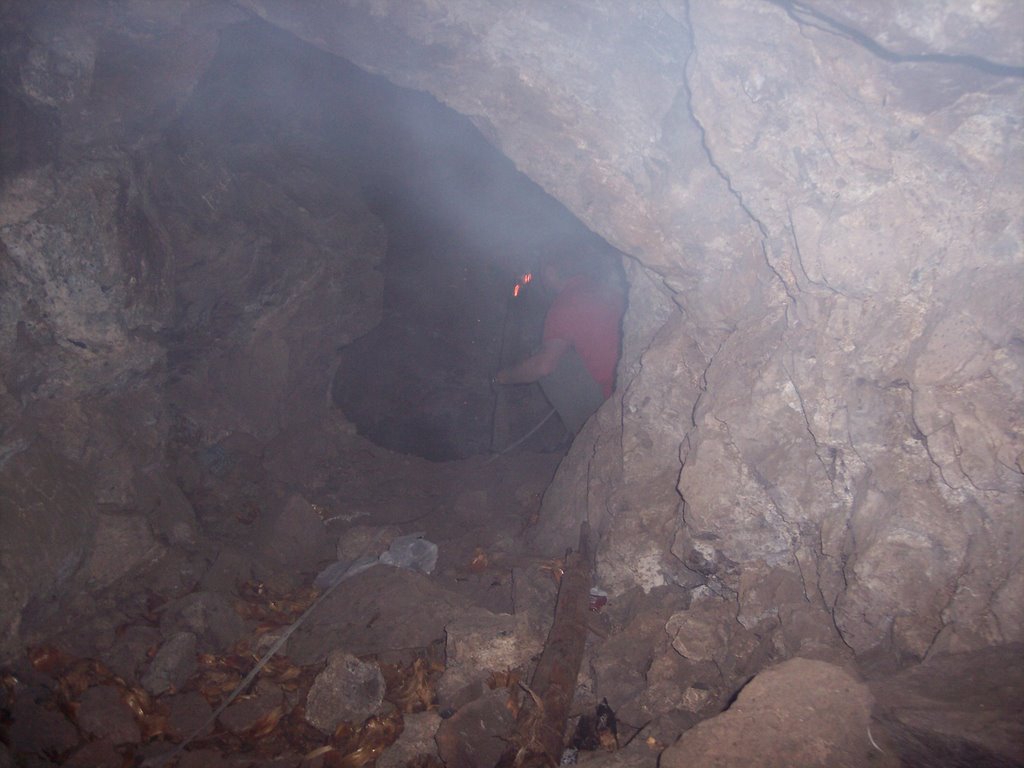
I plan to head back down this summer to excavate at El Pueblito in an attempt to get some Southwest experience in the dirt. No money, but the place is beautiful and has incredible archaeology. There is plenty of room on the crew if anyone is interested. Todd Pietzel would love to have you and is even going to pay for food and board.
 This last one is of me climbing up to a second cave just up from one of the trails. There was nothing in there but the scraps of a hawk's delicious meal (a chicken perhaps).
Lay-tar.
Friday, April 14, 2006
Self-praise
Quick FoF member update. Two of us (Jenny and myself) participated in the Fulton Mentored Reseach Poster thing. I walked away with first place (in the department) for my poster on Spotten Cave and Jenny was awarded second place for her poster on Fremont settlement patterns near Vernon, Utah.
I feel that this is vindication for the obsdidian incident last year.
Also, the majority of us passed the comps. What a relief!
I feel that this is vindication for the obsdidian incident last year.
Also, the majority of us passed the comps. What a relief!
Wednesday, April 12, 2006
Hello!
I just returned from a week and a half in Parowan valley, sorry for the lack of posting... By now I think I have been to most of the canyons along the hurricane cliffs. Some canyons are completely lacking any materials suitable for clay, however there are good quality clays coming from the canyons near Parowan and Paragonah. Im taking into consideration both options; either the ceramics were produced from a single self tempering material, or the combination of separate temper and clay materials. I did locate a volcanic ash that is altered to the point of being a clay, it also contains biotite mica , feldspar and quartz. Currently im favoring the other option of separate clay and temper materials, although it has been difficult to locate appropriate tempering materials.
New available publications
Just so everybody will have easy access, two new publications have been added to the sidebar. David's rabbit coat project and Chris's condensed thesis. If anybody has others, send them my way. It looks like I have a place to host them for the time being. Don't ask, don't tell.
FOF discovered?
Today at OPA, Molly was reading the blog and Joel came up behind her...
"what is that?" "Friends of the Fremont?" "what is this?"
Molly quickly closed the windo and we told him it was merely a forum for idea exchange.
He shrugged it off but still seemed interested.
This goes back to Chris' question of, "should we involve the mucky-mucks"
I still say no for now. I know that Rich checks the blog every now and then, but for the most part we are fairly insular.
"what is that?" "Friends of the Fremont?" "what is this?"
Molly quickly closed the windo and we told him it was merely a forum for idea exchange.
He shrugged it off but still seemed interested.
This goes back to Chris' question of, "should we involve the mucky-mucks"
I still say no for now. I know that Rich checks the blog every now and then, but for the most part we are fairly insular.
Tuesday, April 11, 2006
Thesis Feedback
First of all, I'd like to thank everyone who has given me feedback on my thesis and the truncated versions I have circulated. If anyone else would like a pdf of my condensed (35 page) thesis, please email me (watkins.chris@gmail.com). Maybe I should send it to Mike for online posting...
I decided to email a couple of people who I thought would be interested in my thesis (Alan Reed of Alpine Archaeology and Margaret Lyneis, formerly of UNLV) to let them know that it had been posted online. I have gotten some good initial feedback with promises of more.
I was a little anxious about shopping my thesis around, and I thought that I would share that I had a good experience. I think we should take advantage of the online nature of our theses and alert people who we think may be interested. It seems to be working for me thus far.
I decided to email a couple of people who I thought would be interested in my thesis (Alan Reed of Alpine Archaeology and Margaret Lyneis, formerly of UNLV) to let them know that it had been posted online. I have gotten some good initial feedback with promises of more.
I was a little anxious about shopping my thesis around, and I thought that I would share that I had a good experience. I think we should take advantage of the online nature of our theses and alert people who we think may be interested. It seems to be working for me thus far.
Friday, April 07, 2006
Um...sorry Holly:
Preemptive Haiku
Holly, you are just half-baked
Contribute or leave!
Holy Crap! I jest
But it's just for your own good.
We want you with us.
And I still love you,
Despite your Old World fetish.
It's just so easy.
Now come be our cook,
And all will be forgiven.
Peer pressure is right.
Holly, you are just half-baked
Contribute or leave!
Holy Crap! I jest
But it's just for your own good.
We want you with us.
And I still love you,
Despite your Old World fetish.
It's just so easy.
Now come be our cook,
And all will be forgiven.
Peer pressure is right.
New Links
Some of you may have noticed that I added a "publications" section on the sidebar linking to the theses written by Dave, Mike, and myself. Does anyone alse have any publivcations they'd like to link to? And I guess I should have asked Dave and Mike if they wanted their theses linked to. Let me know if not and I'll take them down.
Here's My Take on the Year
Beef, chicken, pork – Gross!
Vegetarian at last
Oh I’m Lovin’ it!
__________________________
Traffic that goes for miles
A Vegas nightmare
__________________________
Baskets, alcoves, seeds, oh my
But no aliens
__________________________
Thought Bones was a great target
Kicked out on his a**!
Here is to another year
Sorry I didnt get these out yesterday, but here they are, and long live FOF:
Tropic, Moab, Price
Escalante is so nice
and Green River too
_____
Living on the road
eating from old AP2
Life with OPA...
_____
Drink sweet, sweet, Fresca
Nectar of the desert gods,
can you have too much?
_____
Friends of the Fremont.
Defenders of the lost ones.
They will rise again.
_____
Silicon and dust
Techno-Archaeology,
Future meets the past.
_____
Flakes and Stone Tools;
Manos and Metates too.
Love the stones and bones.
Tropic, Moab, Price
Escalante is so nice
and Green River too
_____
Living on the road
eating from old AP2
Life with OPA...
_____
Drink sweet, sweet, Fresca
Nectar of the desert gods,
can you have too much?
_____
Friends of the Fremont.
Defenders of the lost ones.
They will rise again.
_____
Silicon and dust
Techno-Archaeology,
Future meets the past.
_____
Flakes and Stone Tools;
Manos and Metates too.
Love the stones and bones.
Thursday, April 06, 2006
Odes to Field Schools
As I sit here guilty,
Thinking on the tents to check
And equipment needs:
First Escalante-
Not like later and Club Sean,
Stories now depress.
First Santa Clara-
Research design looks groovy,
Will we have a cook?
Field trip to first camp-
These kids will be spoiled rotten
Flush toilets, showers!
Thinking on the tents to check
And equipment needs:
First Escalante-
Not like later and Club Sean,
Stories now depress.
First Santa Clara-
Research design looks groovy,
Will we have a cook?
Field trip to first camp-
These kids will be spoiled rotten
Flush toilets, showers!
Now and then
They did what! No way
I’m offended, oh my heck
Daily Universe
Molly Mormon who?
Contacting book store, uh oh
Shouts of anger
Jewel and peasant quest?!
What about Capital Reef?
After level four
Unshaven, unkempt
No problem at library
Unspoken delight
Lapdances….5 bucks!
Vegas filth, wretched hive
Bad as Mos Eisley
I’m offended, oh my heck
Daily Universe
Molly Mormon who?
Contacting book store, uh oh
Shouts of anger
Jewel and peasant quest?!
What about Capital Reef?
After level four
Unshaven, unkempt
No problem at library
Unspoken delight
Lapdances….5 bucks!
Vegas filth, wretched hive
Bad as Mos Eisley
Provo Nostalgia
High profile campus.
Pillar of academics!
I miss Rich and Lane...
In-N-Out Burger
I can eat the Jumbo Jack
J-Dawgs they are not
Zelda on bootleg
"Rosemary, heaven restores..."
Cut it! Here comes Joel!!
Oh crap, what the H?
(Yada-yada-yada) State!
Finger for Holly
Polar Bear Mudbath
We hitched a ride with a Swede
They heat-treated wha?!
Celebration Haikus
Tribute to the Blog:
A brilliant blog
Established in great wisdom
Idea exchange
ASU, OU
UNLV, BYU
Interscholastic!
Tribute to the Fremont
Long lost farming friends
Defamed, slandered...Foragers?
Peripheral pals.
Five Finger Ridge site
Important Contribution
Ignored by Utah
A constant culture
Or variable Sevier?
I vote for constant
Tribute (or lament) to the MPC
Plum blossoms outside
Cool breeze, light April showers
Stuffy in this place
Will we get AC?
Only April, sweltering
Can't wait for July
A brilliant blog
Established in great wisdom
Idea exchange
ASU, OU
UNLV, BYU
Interscholastic!
Tribute to the Fremont
Long lost farming friends
Defamed, slandered...Foragers?
Peripheral pals.
Five Finger Ridge site
Important Contribution
Ignored by Utah
A constant culture
Or variable Sevier?
I vote for constant
Tribute (or lament) to the MPC
Plum blossoms outside
Cool breeze, light April showers
Stuffy in this place
Will we get AC?
Only April, sweltering
Can't wait for July
Tuesday, April 04, 2006
April 6th -- One year of FOF
I just noticed that Thursday will mark the 1 year anniversary of Friends of the Fremont. Any ideas on how to celebrate? Perhaps we should all submit a haiku in commemoration...
Thursday, March 30, 2006
Saturday, March 25, 2006
Hi,
Hi Chris, Folsom8k, and others…
First of all thanks for letting me join the Blog, it seems to be a good group of people that are passionate about archaeology. As was requested here’s little about myself; as of now I am looking for work in archeology, having applied to various CRM firms and BLM offices. I want to gain more practical experience in archaeology. I am also applying to grad school, with the goal of entering in the fall of 2007.
All the work I have been doing recently in archeology has been of my own interest. I have been working on sourcing materials such as obsidian and clays. In October I spent two weeks collecting samples from obsidian locations, which were submitted for xrf analysis. However my main interest has been sourcing the clay materials for SVG ceramics. I have spent three weeks hiking around Parowan valley analyzing the geology and collecting samples. I have done this work so far, keeping in mind all the issues presented in the paper by,
Dean E. Arnold, Hector Neff, Ronald L. Bishop.
“Compositional Analysis and “Sources” of pottery: An Ethnoarcheological Approach” 1991
This topic has interested me, mainly because I love ceramics, archeology and the Great Basin, and working with these ceramics is a combination of all three. I was first introduced to Fremont archaeology in the Eagle Valley field school hosted by Uc Davis. Since then I have been working with Clint, and developing various project ideas.
First of all thanks for letting me join the Blog, it seems to be a good group of people that are passionate about archaeology. As was requested here’s little about myself; as of now I am looking for work in archeology, having applied to various CRM firms and BLM offices. I want to gain more practical experience in archaeology. I am also applying to grad school, with the goal of entering in the fall of 2007.
All the work I have been doing recently in archeology has been of my own interest. I have been working on sourcing materials such as obsidian and clays. In October I spent two weeks collecting samples from obsidian locations, which were submitted for xrf analysis. However my main interest has been sourcing the clay materials for SVG ceramics. I have spent three weeks hiking around Parowan valley analyzing the geology and collecting samples. I have done this work so far, keeping in mind all the issues presented in the paper by,
Dean E. Arnold, Hector Neff, Ronald L. Bishop.
“Compositional Analysis and “Sources” of pottery: An Ethnoarcheological Approach” 1991
This topic has interested me, mainly because I love ceramics, archeology and the Great Basin, and working with these ceramics is a combination of all three. I was first introduced to Fremont archaeology in the Eagle Valley field school hosted by Uc Davis. Since then I have been working with Clint, and developing various project ideas.
Wednesday, March 22, 2006
Abbreviated Thesis
I've managed to cut the main point of my thesis down to about 35 pages in preparation for publication. This is probably much more readable than the full text. I have a pdf of the draft if anyone would care to look at it. I would appreciate comments before submitting it for publication.
Cady has a copy of the pdf the Provo folks could get, otherwise email me (watkins.chris@gmail .com) for a copy.
Cady has a copy of the pdf the Provo folks could get, otherwise email me (watkins.chris@gmail .com) for a copy.
Monday, March 20, 2006
Sunday, March 19, 2006
Fremont Foragers?
In response to Jenny:
I think I did a pretty good job of starting to deconstruct the concept of Fremont foragers in my thesis. Essentially, the only "evidence" for a Fremont foraging strategy is found in the west desert and Great Salt Lake Marshes, unless you count Madsen's cattail extravaganza at Backhoe (and I for one don't, I'd bet the farm that there were mats on those pithouse floors).
In my thesis, I argue that in places where Fremont territory abuts foragers, there is a fuzzy border. Conversely, to the south where they are butting up against other farmers, there is a clear social boundary. We see this in the pottery. It all depends on what you want to call Fremont. I call the foragers cozying up to the Fremont farmers butt-kissers who are trying to get their hands on corn. They're either marginalized former Fremont, or people coming in from other foraging groups who are trying to cash in on corn and a higher prestige lifeway.
I have yet to see any believable evidence for a true Fremont forager from an area that is not a borderland. The whole argument is based on cattail at Backhoe and evidence from areas without a clear social boundary. It has no legs to stand on.
I think I did a pretty good job of starting to deconstruct the concept of Fremont foragers in my thesis. Essentially, the only "evidence" for a Fremont foraging strategy is found in the west desert and Great Salt Lake Marshes, unless you count Madsen's cattail extravaganza at Backhoe (and I for one don't, I'd bet the farm that there were mats on those pithouse floors).
In my thesis, I argue that in places where Fremont territory abuts foragers, there is a fuzzy border. Conversely, to the south where they are butting up against other farmers, there is a clear social boundary. We see this in the pottery. It all depends on what you want to call Fremont. I call the foragers cozying up to the Fremont farmers butt-kissers who are trying to get their hands on corn. They're either marginalized former Fremont, or people coming in from other foraging groups who are trying to cash in on corn and a higher prestige lifeway.
I have yet to see any believable evidence for a true Fremont forager from an area that is not a borderland. The whole argument is based on cattail at Backhoe and evidence from areas without a clear social boundary. It has no legs to stand on.
Chirping Crickets...
Hopefully now that the comps are over, we will see a flurry of activity.
Here's an update from the BYU neck of the woods...
(and not just my neck! HA!...lame...stupid...sorry)
Anyway, all of the first year grads are now breathing a sigh of relief since the comps are done. Now, we can only hope to pass.
The fieldschool is quickly approaching. It has been interesting to see the difference in expectations from Jim Allison. Many of the "vital" things that were field school necessities in the past (according to Joel) are being done away with. Elimination of the "Brother Love Revival Tents" and the Van Pelt Trailer have been discussed. Also, we have had several students drop out and now only have 16 (Jenny, correct me if I'm off numerically)
Jim has drafted the research design, and if I (or Jenny) have time, I'd like to post the key elements of it on FoF. It would be great to see some of your input.
The Fulton Research thing is coming up, in which we all kiss Ira's millionare derriere and get a free lunch. Chris, I thought about a repisal submission for our "Obsdidian" poster, but decided against it. Instead, I will be doing a poster on "Spottsen Cove". I think that mispelling all of my posters could become a signature trademark.
Also, we should be thinking about the GBAC and some of us (ex. arch session participants) should be thinking about sending me some abstracts. I will be drafting a proposal, my own abstract, and sending out a few e-mails, so be on the lookout. I also need to talk to JEC soon.
I know there is more, but I'll let the rest of you tack it on in the comments or other posts.
Here's an update from the BYU neck of the woods...
(and not just my neck! HA!...lame...stupid...sorry)
Anyway, all of the first year grads are now breathing a sigh of relief since the comps are done. Now, we can only hope to pass.
The fieldschool is quickly approaching. It has been interesting to see the difference in expectations from Jim Allison. Many of the "vital" things that were field school necessities in the past (according to Joel) are being done away with. Elimination of the "Brother Love Revival Tents" and the Van Pelt Trailer have been discussed. Also, we have had several students drop out and now only have 16 (Jenny, correct me if I'm off numerically)
Jim has drafted the research design, and if I (or Jenny) have time, I'd like to post the key elements of it on FoF. It would be great to see some of your input.
The Fulton Research thing is coming up, in which we all kiss Ira's millionare derriere and get a free lunch. Chris, I thought about a repisal submission for our "Obsdidian" poster, but decided against it. Instead, I will be doing a poster on "Spottsen Cove". I think that mispelling all of my posters could become a signature trademark.
Also, we should be thinking about the GBAC and some of us (ex. arch session participants) should be thinking about sending me some abstracts. I will be drafting a proposal, my own abstract, and sending out a few e-mails, so be on the lookout. I also need to talk to JEC soon.
I know there is more, but I'll let the rest of you tack it on in the comments or other posts.
Tuesday, March 14, 2006
GIS Class
I know this really only applies to those still at BYU, but I thought I'd let you know that the GIS class (Geog 503) has expanded to 14 seats...looks like we will be able to weasel our way into it after all!
NSF and Curation Crisis
NSF reviewers can bite me. As some of you may know I applied for an NSF dissertation improvement grant a little while ago. I received notification from the project director (John Yellen) that I would not be receiving funds. Yellen was way cool and offered to discuss any of the reviews I wanted to go over. Seems like a helpful guy. One of the reviews was “Very Good”, the other two reviews were “Fair”. By the NSF rules if you have even one “fair” you’re out. The two reviewers who gave me fair had some good points. Basically they both said that I need to discuss my specific hypotheses more and my methodology. Which is fine. I had kept me proposal kinda general because I wasn’t sure exactly what they wanted. Both “fair” reviewers said they would like to see my project funded, I just have to make those changes. Fortunately, you can re-apply when ever you want with the dissertation grant. So I’ll be fixing the problems and sending it back in….hopefully in a month or two. They were fast at reviewing it, only a month. So for any of you who will be applying for an NSG Dissertation Improvement Grant, there is a lesson for you. When I rewrite and get accepted (which I will!) if any of you are interested in getting a copy so you can see the format and what they are looking for just let me know. Or if you have questions about the process....because “Fastlane” was freaking confusing at first.
As some of you may know, on the side I’m interested in the “Curation Crisis” (the YAR will live one day!). Lately, I’ve been curious as to the percentage of MA’s or PhD’s that are completed using new archaeological data vs. those based on curated collections. I’ve been sending out a survey to archaeology faculty all over the country to help get this info. I’m hoping to write up a little article on it. My main bone to pick right now is that professors don’t really push collections at the MA level. I mean many suggest it, but I think departments should make a concerted effort to have their MA’s use unanalyzed collections. This would really help with getting this information off of the dusty useless shelves and into the literature. Yeah for Cady. So if you overhear any of the faculty at your school saying “Did you get this damned survey from some kid named Yoder at UNLV?!”, politely suggest that completion of the survey shouldn’t take more than 5 minutes and the gods of archaeology will bless them with cosmic karma. May all the weather on your excavations be 65 degrees with sunny skies.
As some of you may know, on the side I’m interested in the “Curation Crisis” (the YAR will live one day!). Lately, I’ve been curious as to the percentage of MA’s or PhD’s that are completed using new archaeological data vs. those based on curated collections. I’ve been sending out a survey to archaeology faculty all over the country to help get this info. I’m hoping to write up a little article on it. My main bone to pick right now is that professors don’t really push collections at the MA level. I mean many suggest it, but I think departments should make a concerted effort to have their MA’s use unanalyzed collections. This would really help with getting this information off of the dusty useless shelves and into the literature. Yeah for Cady. So if you overhear any of the faculty at your school saying “Did you get this damned survey from some kid named Yoder at UNLV?!”, politely suggest that completion of the survey shouldn’t take more than 5 minutes and the gods of archaeology will bless them with cosmic karma. May all the weather on your excavations be 65 degrees with sunny skies.
Monday, March 13, 2006
Kana-a Wha?!?!...
When I came to ASU, I never thought that in a room of archaeologists, I would have the most experience with Tusayan Whitewares. Today as I was analyzing a Colonial Hohokam assemblage, I pulled a whiteware out of the bag. Nobody in the lab could ID it, so I went over to the type collection and called it Kana-a Black-on-white.
Who knew how far the 30 minute lesson Jim gave us in the SW seminar would go?
Who knew how far the 30 minute lesson Jim gave us in the SW seminar would go?
Wednesday, March 08, 2006
Thesis Done...
My thesis is finally complete. If anyone would like a copy before it is posted on-line, let me know and I'll email you a pdf. It's only 2.8 MB.
Monday, March 06, 2006
30th GBAC in Vegas!
As I'm sure you all know the 30th GBAC is in Vegas this year. I figure you're all already aware but they issued a call for papers. The website is http://www.gbac.whsites.net/32.html so check it out! While its still early I thought I'd post the idea of the group getting together one night of the conference and do some catching up. I'm offering my house as the place. We could have a barbecue or pizza or something. Dave only lives a few blocks away from me and we're both close to the strip (abt. 15 mins) so it would be a good location for everyone. Let me know what you think.
Thursday, March 02, 2006
Defining the Fremont on Wikipedia
Some of you may be familiar with the online encyclopedia Wikipedia.
I looked up the Fremont today and noticed that there was very little devoted to them. In fact, the Fremont page is nothing more than a "stub". Wikipedia allows various people to expand stubs with more information, making the entry better.
It would be cool to throw together a basic overview of the Fremont and submit it to Wikipedia.
This would accomplish two goals:
1. People could be more informed about the Fremont
2. We could spin it to fit our theories.
Then, when O'Connel, Ugan, or Hey-sus stumble across the Wikipedia page, they will be shocked.
http://en.wikipedia.org/wiki/Fremont_people
I looked up the Fremont today and noticed that there was very little devoted to them. In fact, the Fremont page is nothing more than a "stub". Wikipedia allows various people to expand stubs with more information, making the entry better.
It would be cool to throw together a basic overview of the Fremont and submit it to Wikipedia.
This would accomplish two goals:
1. People could be more informed about the Fremont
2. We could spin it to fit our theories.
Then, when O'Connel, Ugan, or Hey-sus stumble across the Wikipedia page, they will be shocked.
http://en.wikipedia.org/wiki/Fremont_people
Friday, February 24, 2006
Annual UPAC Presentations
Today was the annual UPAC meeting up at State History. Presentations all morning and then they did the business stuff after we all cut out to head back down to Provo. All told there were four presentations from BYU, including Jim Allison, Rachel Pollock and Mark Bodily, Brad, and I. Topics varied, I'd say Brad's North Creek junk is top list, but I'm still having nightmares from J-in-the-cliff...shudder...
Anyway, one presentation, which I unfortunately didn't really take notes on, was done by a UofU Doctoral student. I'd say it was the most interesting to me, so I wanted to throw out a bit of what I remember for you all.
It dealt with a mass burial in Moab. Six individuals, all male and all between 13-25 years old. Dentition and bone condition suggest that they were all in good health when they died. Three showed similar healed cranial injuries including a segment of bone/incised trauma above the right eye and several blunt trauma episodes to parietal and occipital lobes. Etc, etc, interesting stuff about the bones, but the really intriguing bit is the way the bodies were laid out in the mass grave. Unfortunately I have sucky MS Paint and that's it for graphic edits so I can't crop and rotate this correctly, but it gives you the basic idea:

Each burial was placed face down, with layered bodies having heads placed over the thoracic trunk and down. So they're actually at an angle, which I can't do in Paint, such that the six piled up a bit and then sloped back off.
Has anyone seen anything like this? It's really a bizarre bit of activity.
She didn't say anything about grave goods. She did note that the two common skull shapes for Utah burials (one more spherical/robust typically associated with Fremont/Anasazi culture and one more elongated not consistently identified to any specific culture) were represented in the grave, a good indication that cranial morphology shouldn't be standing alone in our cultural affiliation calls.
Anyway, interesting bit. Wish I had her graphic or better technology on my lappy...but anybody got any thoughts?
Anyway, one presentation, which I unfortunately didn't really take notes on, was done by a UofU Doctoral student. I'd say it was the most interesting to me, so I wanted to throw out a bit of what I remember for you all.
It dealt with a mass burial in Moab. Six individuals, all male and all between 13-25 years old. Dentition and bone condition suggest that they were all in good health when they died. Three showed similar healed cranial injuries including a segment of bone/incised trauma above the right eye and several blunt trauma episodes to parietal and occipital lobes. Etc, etc, interesting stuff about the bones, but the really intriguing bit is the way the bodies were laid out in the mass grave. Unfortunately I have sucky MS Paint and that's it for graphic edits so I can't crop and rotate this correctly, but it gives you the basic idea:

Each burial was placed face down, with layered bodies having heads placed over the thoracic trunk and down. So they're actually at an angle, which I can't do in Paint, such that the six piled up a bit and then sloped back off.
Has anyone seen anything like this? It's really a bizarre bit of activity.
She didn't say anything about grave goods. She did note that the two common skull shapes for Utah burials (one more spherical/robust typically associated with Fremont/Anasazi culture and one more elongated not consistently identified to any specific culture) were represented in the grave, a good indication that cranial morphology shouldn't be standing alone in our cultural affiliation calls.
Anyway, interesting bit. Wish I had her graphic or better technology on my lappy...but anybody got any thoughts?
Tuesday, February 21, 2006
Image J - Free visual analysis software
Some of us have been messing around with Image J, a piece of freeware that will analyze digital photographs. Cady, Scott, and myself are trying to get a paper together where we will try to see if we can tell if Boulder Jasper has been heat treated by analyzing the level of light refraction and color of samples before and after heat treating.
There are many, many plug-ins and many, many possible applications of this technology. Everybody check it out. Best of all, it's free...
There are many, many plug-ins and many, many possible applications of this technology. Everybody check it out. Best of all, it's free...
Friday, February 17, 2006
Hutchings Museum and Renee Barlow
Last night, several of us (Molly, Holly, Cady, Jenny, and I) went to the USAS meeting at the Hutchings museum in Lehi, Utah.
Renee Barlow was the guest and talked about....you'll never guess....Range Creek. During her lecture she said several things that seemed like "red flags". One of the red flags was her use of the term "Pithouse Village". After being asked what her definition of a pithouse village was, she suggested that a pithouse village in Range Creek could have as few as 3 pithouses and as many as 15.
Has she read Five Finger, or Clear Creek? Is she aware of Parowan Valley?
To her credit, Barlow did say somethings that sounded like a small shift in research bias, but I'll let Cady talk about those.
Also, The Hutchings museum has an amazing collection of chipped stone artifacts, perishables, and all sorts of eccentrics (figurines, incised stones, and other oddities) that we rarely get to see.
The collection was so amazing that our very own Old-Worlder,Holly A. Raymond, expressed her admiration for the material culture of the Fremont. Holly, I'll let you elaborate.
Something about doing a thesis on the Fremont instead....
I'm sure I left a few things out, everyone else who was there should throw in your summaries or impressions.
Renee Barlow was the guest and talked about....you'll never guess....Range Creek. During her lecture she said several things that seemed like "red flags". One of the red flags was her use of the term "Pithouse Village". After being asked what her definition of a pithouse village was, she suggested that a pithouse village in Range Creek could have as few as 3 pithouses and as many as 15.
Has she read Five Finger, or Clear Creek? Is she aware of Parowan Valley?
To her credit, Barlow did say somethings that sounded like a small shift in research bias, but I'll let Cady talk about those.
Also, The Hutchings museum has an amazing collection of chipped stone artifacts, perishables, and all sorts of eccentrics (figurines, incised stones, and other oddities) that we rarely get to see.
The collection was so amazing that our very own Old-Worlder,Holly A. Raymond, expressed her admiration for the material culture of the Fremont. Holly, I'll let you elaborate.
Something about doing a thesis on the Fremont instead....
I'm sure I left a few things out, everyone else who was there should throw in your summaries or impressions.
Thursday, February 16, 2006
AP2 in trouble?
AP2, our archaeological chariot, is currently in the shop for an assessment to determine if she can continue for ten thousand more miles.
Thoughts and prayers are welcome.
If she does not survive, might I suggest a memorial order. Perhaps, "The Order of the Yukon".
This order would honor those who have shown excellence in the field, research, off-driving skills or whatever else.
Just a way to remember the vehicle most of us has eaten in, slept in, and traveled in for the majority of our burgeoning careers.
Thoughts and prayers are welcome.
If she does not survive, might I suggest a memorial order. Perhaps, "The Order of the Yukon".
This order would honor those who have shown excellence in the field, research, off-driving skills or whatever else.
Just a way to remember the vehicle most of us has eaten in, slept in, and traveled in for the majority of our burgeoning careers.
Wednesday, February 15, 2006
A Moving Chronological Southwestern Map
I've been thinking lately about the different fluctuations in the population of Southwestern traditions. Lekson has his opinions on major migrations of people through time (See Chaco Meridian). Most agree that at one point or another there were also migrations from the Western Anasazi area to the East (
For me, it is hard to visualize what groups (or areas of the SW) were in "full-swing" at particular times. It seems that the groups who were contemporaneous, especially while sustaining large populations, most likely had contact with groups in similar situations. For example, there was an increase in population at
So, here is my idea. Like I said earlier, I have a hard time visualizing which groups were at their population peak at which times. I've been thinking of building a moving map of the Southwest in Adobe AfterEffects or Flash that shows how these major centers of activity grew and shrank over time. By doing so, we get a better idea of how and when these groups might have interacted or when divisions and migrations may have occurred due to ecological stress. It seems ominous to collect all of the information on this, but would prove useful, maybe only on a teaching level, showing how these groups emerged, blossomed, and later abandoned their homes. Let me know what you guys think.
Sunday, February 12, 2006
OPA, FOF, GB all stars? On a stamp?
Not to detract from Jenny's recent post about lithic scatters (I will comment soon), but I found a really cool website that allows you to make USPS approved stamps using your own photos.
I think this would be a great way to get some fun images circulating through the nation. Imagine- a "tribute to trowels". Imagine--a FoF stamp or an "OPA-Nouveau" stamp designed Mr. Ure! Finally, imagine a "Great Basin All Stars" series. Once every few months we could get a new one.
The possibilities are endless. A little more expensive, but endless.
Here is the link:
Photostamps.com
I think this would be a great way to get some fun images circulating through the nation. Imagine- a "tribute to trowels". Imagine--a FoF stamp or an "OPA-Nouveau" stamp designed Mr. Ure! Finally, imagine a "Great Basin All Stars" series. Once every few months we could get a new one.
The possibilities are endless. A little more expensive, but endless.
Here is the link:
Photostamps.com
On the Ground
I’ve got a question for the general audience relating somewhat to fire issues, more to obsidian dating:
I work a lot out in southern Tooele County on the Vernon parcel of the Forest (ok, as if most of you haven’t heard me compulsively raving about the joys of Vernon…). Long story short, we see tons of little non-descript lithic scatters, mostly Fremont in my book, but quite a few have Archaic points. Most sites have at least a few little bits of obsidian, though I’d say the points are more often chert. There are typically no associated features and very few ceramics, but a lot of these suckers are huge (most of the sites are strung out along the creek beds and can be as long as a mile or more).
Now here’s the issue. For years, my boss has put off making an eligibility statement on any of them because she and Dykmann have gone back and forth about the whole potential to contribute scientific information. There is a distant possibility that they may have buried deposits, but not even enough evidence to justify a test pit (though we’ve put a few in over the years and generally don’t see anything besides lithics in the first 10 cm—to complicate it more, most of the area has been cultivated or chained, or both!). Dykmann’s primary argument, though, is that we can’t call them Unknown Aboriginal and Not Eligible simply because, in his book, we could technically do obsidian hydration on every site. I guess he wants them all Eligible. Problem is, we’ve got documentation of burns over almost the entire Vernon unit, and no doubt, of course, that there have been fires prehistorically as well.
So what do you think? I’m not hugely familiar with obsidian dating, but I know fire can reset the clock. If we don’t have buried deposits (particularly because things have been so disturbed historically) deep enough that the obsidian has been protected, could we ever really trust hydration dates? And is it even remotely worth dating little scatters that don’t even have diagnostic points? Obviously, part of the issue has been solved with Dykmann’s retirement, although maybe Seddon will have a problem, too, but I’m looking to finish up these forms and write an article or two on the prehistory of Rush Valley one of these days and it’d help to have a solid grounding on eligibility. It’s a neat little microcosmic world out there, with some cool patterns, so the report really deserves to be published.
Any thoughts are appreciated. Apologies to any anti-CRM among us who take horror at the thought of being reduced to discussing National Register status. =)
I work a lot out in southern Tooele County on the Vernon parcel of the Forest (ok, as if most of you haven’t heard me compulsively raving about the joys of Vernon…). Long story short, we see tons of little non-descript lithic scatters, mostly Fremont in my book, but quite a few have Archaic points. Most sites have at least a few little bits of obsidian, though I’d say the points are more often chert. There are typically no associated features and very few ceramics, but a lot of these suckers are huge (most of the sites are strung out along the creek beds and can be as long as a mile or more).
Now here’s the issue. For years, my boss has put off making an eligibility statement on any of them because she and Dykmann have gone back and forth about the whole potential to contribute scientific information. There is a distant possibility that they may have buried deposits, but not even enough evidence to justify a test pit (though we’ve put a few in over the years and generally don’t see anything besides lithics in the first 10 cm—to complicate it more, most of the area has been cultivated or chained, or both!). Dykmann’s primary argument, though, is that we can’t call them Unknown Aboriginal and Not Eligible simply because, in his book, we could technically do obsidian hydration on every site. I guess he wants them all Eligible. Problem is, we’ve got documentation of burns over almost the entire Vernon unit, and no doubt, of course, that there have been fires prehistorically as well.
So what do you think? I’m not hugely familiar with obsidian dating, but I know fire can reset the clock. If we don’t have buried deposits (particularly because things have been so disturbed historically) deep enough that the obsidian has been protected, could we ever really trust hydration dates? And is it even remotely worth dating little scatters that don’t even have diagnostic points? Obviously, part of the issue has been solved with Dykmann’s retirement, although maybe Seddon will have a problem, too, but I’m looking to finish up these forms and write an article or two on the prehistory of Rush Valley one of these days and it’d help to have a solid grounding on eligibility. It’s a neat little microcosmic world out there, with some cool patterns, so the report really deserves to be published.
Any thoughts are appreciated. Apologies to any anti-CRM among us who take horror at the thought of being reduced to discussing National Register status. =)
Friday, February 10, 2006
Wow, more secret messages
For those of you who did not notice, the word "hell" in Holly's post "An Open Letter" is a link. Scroll down and check it out. What were you trying to say, Holly?
Thursday, February 09, 2006
Haikus for the Forgotten
For Mike and Scott:
Anthro research lab
"You can't use that in the film!"
Re-do, re-do, damn.
For Cady:
Parowan turquoise
Sourcing? Isn't that Joel's thing?
Academic thief
Anthro research lab
"You can't use that in the film!"
Re-do, re-do, damn.
For Cady:
Parowan turquoise
Sourcing? Isn't that Joel's thing?
Academic thief
Wednesday, February 08, 2006
Mr. Yoder's Thesis: On-Line!
I forgot to previously mention that my thesis is now on-line at BYU. It feels good to have it done. Here's the link:
http://contentdm.lib.byu.edu/ETD/image/etd1052.pdf
Now what you do is go to this link and then scroll down to page number 9. Increase magnification to about 300% and look on the left hand side of the image. The excavators of North Creek, forever immortalized.
http://contentdm.lib.byu.edu/ETD/image/etd1052.pdf
Now what you do is go to this link and then scroll down to page number 9. Increase magnification to about 300% and look on the left hand side of the image. The excavators of North Creek, forever immortalized.
Tuesday, February 07, 2006
An Open Letter
Dear Everyone,
I've made haikus for all!
A Haiku for Chris:
Ho-ho-ho- wha? who?
Ho-ho-what the h? who cares?
More like, ho-ho-krap
A Haiku for Jenny:
Are you kidding me?
Rusty nails and can scatters
You get paid for this?
Oh, another haiku for Jenny!
Hole-in-top, matchstick?
Insignificant cowboys
Boring, boring, dumb
A Haiku for Aaron and the Fremont:
Fremont foragers
Don't loose your rabbit stick now!
Smelly pithouses
A Haiku for the Nabataeans:
Written language, kings,
Monumental structures....hmm..
Sounds like it's a state!
A Haiku for State-level societies:
Important cultures
Romans, Greeks, and Egyptians
No snail suckers here!
A Haiku for North American Archaeologists:
Burial digging
Don't let NAGPRA keep you down!
Night excavations
Now you can all pack your bags and go to Hell-
Love,
Holly
I've made haikus for all!
A Haiku for Chris:
Ho-ho-ho- wha? who?
Ho-ho-what the h? who cares?
More like, ho-ho-krap
A Haiku for Jenny:
Are you kidding me?
Rusty nails and can scatters
You get paid for this?
Oh, another haiku for Jenny!
Hole-in-top, matchstick?
Insignificant cowboys
Boring, boring, dumb
A Haiku for Aaron and the Fremont:
Fremont foragers
Don't loose your rabbit stick now!
Smelly pithouses
A Haiku for the Nabataeans:
Written language, kings,
Monumental structures....hmm..
Sounds like it's a state!
A Haiku for State-level societies:
Important cultures
Romans, Greeks, and Egyptians
No snail suckers here!
A Haiku for North American Archaeologists:
Burial digging
Don't let NAGPRA keep you down!
Night excavations
Now you can all pack your bags and go to Hell-
Love,
Holly
Saturday, February 04, 2006
A request for Resurrection:
So, I was sitting around trying to avoid writing my Western Shoshone paper for Great Basin and, as has become a somewhat ritualistic habit in the past month, wandered over to FOF for a bit of light reading. I couldn’t get past the Dashboard all day, however, with two results: 1) You were all spared a number of lame and/or dry comments on such things as I generally know nothing about…you may now stop celebrating, thank you, and read 2) I did a search for FOF to try a back way in and ended up accessing the first three or so lines of the last 82 some odd posts on a Blogger search page that was actually working.
I’ll grant that it was a stunted view of what’s gone on over the life of the blog, but I’m slightly disturbed at the loss of a lovely tradition that seemed to be burgeoning.
Where is the haiku?
I think it was a nice touch.
And Holly was alive.
Sniff.
I’ll grant that it was a stunted view of what’s gone on over the life of the blog, but I’m slightly disturbed at the loss of a lovely tradition that seemed to be burgeoning.
Where is the haiku?
I think it was a nice touch.
And Holly was alive.
Sniff.
Knorosov: The Decipherment of the Mayan Script
This week at BYU International Cinema, they had a film on Yuri Knorosov, the Soviet linguist who made significant contribuitons to deciphering Mayan glyphs. It was very interesting, including interviews with Michael Coe, excerpts from Diego de Landa's writings, and several great photographs of Mayan ruins.
Towards the end of the film, Knorosov started talking about the origins of the Maya. he suggested that they migrated from the north down into Mesoamerica. Knorosov theorized that the Mayan homeland was somewhere in the American SW.
Knorosov suggested that Mesa Verde may have been of particular importance in the Mayan cave emergence. In other words, K. believed that Mesa Verde may have been the site of the seven caves/seven rivers where the Maya believed they emerged. Knorosov provided no real evidence, he just quoted from the Popul Vul and other Mayan writings.
A lack of evidence aside, this is an interesting idea. Especially since the idea of a southwestern Aztlan has been mentioned by Mike.
So I guess the question is this: Is the Southwest the epicenter of Great Basin and Mesoamerican cultures?
Towards the end of the film, Knorosov started talking about the origins of the Maya. he suggested that they migrated from the north down into Mesoamerica. Knorosov theorized that the Mayan homeland was somewhere in the American SW.
Knorosov suggested that Mesa Verde may have been of particular importance in the Mayan cave emergence. In other words, K. believed that Mesa Verde may have been the site of the seven caves/seven rivers where the Maya believed they emerged. Knorosov provided no real evidence, he just quoted from the Popul Vul and other Mayan writings.
A lack of evidence aside, this is an interesting idea. Especially since the idea of a southwestern Aztlan has been mentioned by Mike.
So I guess the question is this: Is the Southwest the epicenter of Great Basin and Mesoamerican cultures?
Friday, February 03, 2006
AJ Sighting
I have it on a high authority (Lane Richens), that our beloved AJ has been found doing contract work for John Baxter's CRM firm, Bighorn Archaeology. It is also on the records that he is still living in Moronihah and is still working for the Forest Service. Long live the Filfoul! We need to find a way to get him on FOF with us!
Another new feature?
Over the years we've talked a little about doing some kind of "Great Basin Archaeological All-Stars" trading cards. Maybe we could do a trial run here on FOF. We could come up with legitimate profiles for all of our favorite friends, with a brief biography, research interests, and selected bibliography. That way, if we ever talk about "Joel", we could link his name to his profile. This would be particularly helpful for the uninitiated.
On a sidenote, I'm thinking about organizing a lunchtime forum here at ASU to talk about blogging and its potential uses. That might mean a bunch of people looking at this site. We'll see if I decide to do it.
On a sidenote, I'm thinking about organizing a lunchtime forum here at ASU to talk about blogging and its potential uses. That might mean a bunch of people looking at this site. We'll see if I decide to do it.
Tuesday, January 31, 2006
Thanks and Request
Thanks Yoder for your input. That clarified a lot. I have a request for another clarification:
Chris, what I know of the Sinagua tradition is that they are some kind of melding pot of the Snazi, Mogollon and Hohokam, is this true?
Teach us.
Chris, what I know of the Sinagua tradition is that they are some kind of melding pot of the Snazi, Mogollon and Hohokam, is this true?
Teach us.
Basketmakers = Early Fremont?
(Had to make my own post so I could use the colors as emphasis!)
What essentially defines the Basketmakers is time, space, and some material culture. The material culture part generally includes pithouses (though some above ground structures were also used), atlatl use, use and probably reliance on corn, storage features (including rock shelters, dry caves, slablined cists, and bellshaped pits) no ceramics, and all this taking place around a couple hundred years BC to 400 or 500 AD. Does that sound familiar to anyone? What keeps the early Fremont from being Basketmaker? Location. Early Fremont really look a lot like Basketmaker groups. Rich thinks that early Fremonters ARE Basketmakers who in micro migrations expanded up into the Northern Colorado Plateau and Great Basin where they passed on some traits to the indigenious rabbit chasers before being culturally swallowed up. The Steinaker Gap report lays out Rich’s basic argument:
“There is another option seldom considered: small-scale migration of farmers. In this scenario, Basketmaker II nuclear or extended family groups, experienced in maize agriculture, would have spread northward from the more populous regions of northern Arizona, seeking the best arable land (Talbot 1995b). Such groups would have been minority populations in a sea of hunter-gatherers. Enculturation in these settings very likely was reciprocal, with the immigrant farmers sharing knowledge of agriculture and associated technologies, knowledge that ultimately led to widespread adaptive shifts, but with the people themselves inevitable being swallowed up in the local, larger gene pool.”
He goes on to discuss this more, but that’s the main idea. Although I’ve never talked to Janetski about this specifically, generally I don’t think he buys it. He feels that Basketmaker traits diffused slowly into the Fremont region, not through migration, whether large or micro. Although he does think that early Fremont are very similar to Basketmakers. He says:
“these data suggest that indigenous peoples in the central Utah region adopted and adapted new ideas from surrounding areas, both north and south, and gradually, rather than dramatically, shifted to a Formative strategy.”
And….
“These data also suggest that a Basketmaker II-like strategy was present well to the north of the traditional Anasazi area and preceded the better known Formative (Fremont) adaptation in this region”
Good reading on this includes
Talbot, Richard K., and Lane D. Richens
1996 Steinaker Gap: An Early Fremont Farmstead. Museum of Peoples and Cultures Occasional Papers No. 2. Brigham Young University, Provo, Utah.
2004 Fremont Farming and Mobility on the Northern Colorado Plateau: The Steinaker Lake Project. Museum of Peoples and Cultures Occasional Papers No. 10. Brigham Young University, Provo, Utah.
Janetski, Joel C.
1993 The Archaic to Formative Transition North of the Anasazi: A Basketmaker Perspective. In ????(not sure, I’ll find out tonight)
So what’s it all mean? I think that obviously PreFremont or Early Fremont (200 B.C.- 500 A.D.) folks were heavily influenced by Southwesterners. I don’t think that early Fremont and Basketmaker were the same people in the sense of a distinct cultural group, like Americans or Frenchies. Instead they were small groups who shared similar cultural traits, just like Americans and Frenchies live in above ground houses, have a industrialized society, ect. Basketmakers and Early Fremont shared much in subsistence, architecture, and other things, but I don't think archaeologically they should be counted as the same group. In part because early Fremont seems to have been a little later and because they obviously followed different paths in the end. But right now the number of early Fremont sites is very low, so as the database increases this may clear things up considerably. That’s my general view of it all. I think they were very similar, but should be seen and discussed as different groups. Read Rich’s and Janetski’s reports and articles, cause they make their arguments much more clear than I do.
What essentially defines the Basketmakers is time, space, and some material culture. The material culture part generally includes pithouses (though some above ground structures were also used), atlatl use, use and probably reliance on corn, storage features (including rock shelters, dry caves, slablined cists, and bellshaped pits) no ceramics, and all this taking place around a couple hundred years BC to 400 or 500 AD. Does that sound familiar to anyone? What keeps the early Fremont from being Basketmaker? Location. Early Fremont really look a lot like Basketmaker groups. Rich thinks that early Fremonters ARE Basketmakers who in micro migrations expanded up into the Northern Colorado Plateau and Great Basin where they passed on some traits to the indigenious rabbit chasers before being culturally swallowed up. The Steinaker Gap report lays out Rich’s basic argument:
“There is another option seldom considered: small-scale migration of farmers. In this scenario, Basketmaker II nuclear or extended family groups, experienced in maize agriculture, would have spread northward from the more populous regions of northern Arizona, seeking the best arable land (Talbot 1995b). Such groups would have been minority populations in a sea of hunter-gatherers. Enculturation in these settings very likely was reciprocal, with the immigrant farmers sharing knowledge of agriculture and associated technologies, knowledge that ultimately led to widespread adaptive shifts, but with the people themselves inevitable being swallowed up in the local, larger gene pool.”
He goes on to discuss this more, but that’s the main idea. Although I’ve never talked to Janetski about this specifically, generally I don’t think he buys it. He feels that Basketmaker traits diffused slowly into the Fremont region, not through migration, whether large or micro. Although he does think that early Fremont are very similar to Basketmakers. He says:
“these data suggest that indigenous peoples in the central Utah region adopted and adapted new ideas from surrounding areas, both north and south, and gradually, rather than dramatically, shifted to a Formative strategy.”
And….
“These data also suggest that a Basketmaker II-like strategy was present well to the north of the traditional Anasazi area and preceded the better known Formative (Fremont) adaptation in this region”
Good reading on this includes
Talbot, Richard K., and Lane D. Richens
1996 Steinaker Gap: An Early Fremont Farmstead. Museum of Peoples and Cultures Occasional Papers No. 2. Brigham Young University, Provo, Utah.
2004 Fremont Farming and Mobility on the Northern Colorado Plateau: The Steinaker Lake Project. Museum of Peoples and Cultures Occasional Papers No. 10. Brigham Young University, Provo, Utah.
Janetski, Joel C.
1993 The Archaic to Formative Transition North of the Anasazi: A Basketmaker Perspective. In ????(not sure, I’ll find out tonight)
So what’s it all mean? I think that obviously PreFremont or Early Fremont (200 B.C.- 500 A.D.) folks were heavily influenced by Southwesterners. I don’t think that early Fremont and Basketmaker were the same people in the sense of a distinct cultural group, like Americans or Frenchies. Instead they were small groups who shared similar cultural traits, just like Americans and Frenchies live in above ground houses, have a industrialized society, ect. Basketmakers and Early Fremont shared much in subsistence, architecture, and other things, but I don't think archaeologically they should be counted as the same group. In part because early Fremont seems to have been a little later and because they obviously followed different paths in the end. But right now the number of early Fremont sites is very low, so as the database increases this may clear things up considerably. That’s my general view of it all. I think they were very similar, but should be seen and discussed as different groups. Read Rich’s and Janetski’s reports and articles, cause they make their arguments much more clear than I do.
Monday, January 30, 2006
Theories!...Theories everywhere!...
Just so all y'all outside the bubble know, Clark is looking to put together a theory/history of archaeology book for 501/510. He's looking for contributors to write the chapters, so here's your free chance to publish, folks!
If it actually happens, it'll be a good opportunity to really attack a theory or two in-depth and to leave a tidge of a legacy for future generations--spare them reading Hawaiki, I hope. I imagine he'll be up for a goodly number of us putting in on this, so I guess stay-tuned, but be thinking about what theories you specifically want to see in it. He's also planning on a section for statehood, origins of agriculture, etc. Basically it'll be a big study guide for the competency.
If it actually happens, it'll be a good opportunity to really attack a theory or two in-depth and to leave a tidge of a legacy for future generations--spare them reading Hawaiki, I hope. I imagine he'll be up for a goodly number of us putting in on this, so I guess stay-tuned, but be thinking about what theories you specifically want to see in it. He's also planning on a section for statehood, origins of agriculture, etc. Basically it'll be a big study guide for the competency.
Northern Periphery on the Mind
I was reading through Carol Riley's "Becoming Aztlan" (2005) and found an interesting tidbit on the inclusion of the Fremont into the Anasazi Basketmaker tradition. It goes like this...
"The Basketmaker phase of Anasazi extended over much of the San Juan Basin, westward to the lower Virgin River of Southern Nevada, although there is not much evidence for Basketmaker occupation in some areas, for example the north rim of the Grand Canyon. If the enigmatic pithouse-dwelling Fremont tradition can be included, much of Utah and parts of Colorado belonged in the Basketmaker-Pueblo world."
If one of the main characteristics of the Basketmakers is pithouse use (and non-ceramic, of course) then couldn't the earlier Fremont be considered part of this group? What draws the line for exclusion? Is it the fact that they didn't evolve into what is considered a Pueblo tradition but continued using pithouse stuctures? Or is their material culture actually totally distinct/different? Can't we all just get along?
"The Basketmaker phase of Anasazi extended over much of the San Juan Basin, westward to the lower Virgin River of Southern Nevada, although there is not much evidence for Basketmaker occupation in some areas, for example the north rim of the Grand Canyon. If the enigmatic pithouse-dwelling Fremont tradition can be included, much of Utah and parts of Colorado belonged in the Basketmaker-Pueblo world."
If one of the main characteristics of the Basketmakers is pithouse use (and non-ceramic, of course) then couldn't the earlier Fremont be considered part of this group? What draws the line for exclusion? Is it the fact that they didn't evolve into what is considered a Pueblo tradition but continued using pithouse stuctures? Or is their material culture actually totally distinct/different? Can't we all just get along?
Friday, January 27, 2006
Click here!
Hello all: I just finished our anthro. graduate student association website. It's no OPA site, but I was pretty happy with how it turned out, considering I had no idea how to construct a website beforehand. Tell me what you think.
www.ou.edu/agsa
www.ou.edu/agsa
Michael Coe Shallit Lecture
The lecture this year, "Dawn of the Maya Civilization", in my opinion, was one of the better Shallit lectures so far. Dr. Coe really made the lecture understandable for everyone in the audience (and for hacks like me it helps to keep it simple and interesting). He used some really cool 3D models of Mayan temples as well as some great satellite imagery. I guess thats the benefit of working at Yale and being one of the premiere Mayan scholars. One point that he made at the beginning of his lecture concerning theory was very interesting to me. He basically said that he doesnt subscribe to all of the theories that are floating around out there and that they all come and go. He said that he considers himself a cultural historian instead. I found this quite refreshing since I have a hard time with all the theories involved with archaeology in the first place. I am the first to admint my limited knowledge here, but in my mind, let the culture speak for itself. What is the point of having theories that you cannot test and prove right or wrong? I understand that we all have our theories, and on a small scale it makes sense, but these large overriding ideas that are imposed in a one-size fits all doesnt make sense to me. Anyway, I thought Dr. Coe's statement about being a Cultural Historian was interesting and a quiet slap in the face to some of the theorists. I will get off my soap box now...
Tuesday, January 24, 2006
Sinagua Dissertation
When I began working as an RA for Dave Abbott this semester, I little dreamed that the job might turn into such a cool dissertation. Dave has written me into his latest NSF grant where we will be analyzing and redressing the Sinagua ceramic typology and the Sinagua phenomenon in general. If it goes through, I'll be essentially redefining the Sinagua phenomenon for my dissertation.
In the meantime, I'm working on Patayan - Hohokam interactions. Pretty soon, we'll have every boundary covered.
In the meantime, I'm working on Patayan - Hohokam interactions. Pretty soon, we'll have every boundary covered.
Monday, January 23, 2006
Again with the Symposium
I figure I better hurry and post just in case Holly decides to do something brash and actually post--wouldn't want to be branded as she has been.
That said, all I'm gonna say about you sceptics and your anti-historic attitude is...well...ok, I got nothin', but it's still cool. Pass your rust to me, I'll gladly take it. But don't get me wrong, I'll take a pretty lithic scatter over a pile of cans any day of the week.
Now, to the Symposium...
First of all, even now, days later, I can feel my tailbone. The drive was LONG. I tried keeping the 'hey, we're bonding' perspective and that made it slightly more tolerable. 1776 was really enjoyable even though it came in such large blocks.
The first session was definitely the highlight for me, despite its comparative lack of historic discussion, but when it came down to it, I enjoyed the Pueblo talk a lot more than I did any of the Euro-American junk. Traitor to my own cause.
Christine Ward's discussion of lithic procurement. Definitely interesting stuff--a great way to start the conference. Aaron has already discussed it, so I won't.
Donna Glowacki's was a little soft around the edges, but I enjoyed the basic concepts. She discussed The Social Landscape of Depopulation in the northern San Juan. I resonate with the idea of going beyond what's strictly represented on the ground and really trying to bring in our inherent understanding of humans, but getting too post-processualist can rub me the wrong way. In this case, some good points were made and I'll ignore the rest. Notably she suggested that movements in the region, particularly between the east and west, were caused by social differentiation in addition to drought. The east became more ritualistic than the west and that affected the equilibrium. Lot's of food for thought building from this.
Does anyone know of any positive demonstration of the southwest "ball courts"? I mean, yes, they're big flat community areas with seating around, and yes, they're very similar to what we see in Mesoamerica, but do we have associated gaming artifacts? Just curious. I wonder if we tend to just follow along with traditional terminology and let previous biases (such as the standard south to north movement) cloud our ability to read the ground. Ball courts were mentioned, mostly in passing, in a couple of the presentations.
Wendy Ashmore was the discussant, as Aaron mentioned. Her broad discussion of landscape theory was certainly more useful than anything any of the other discussants shared. Her nine factors to be considered were: (1) use of ethnography, (2) consideration of the spatial scale, (3) physical visibility, (4) time, (5) decision making and strategy use, (6) social relations and interaction, (7) movement/pilgrimages, (8) power, and (9) citation circles/networks. I appreciated her inclusion of no. 9—that we need to acknowledge the work being done on the other side of the Atlantic and the Euros need to do the same.
Well, I’m long-winded. The point is that the conference had a lot of good points. I got to see a few token rusty things, particularly in Carol Griffith’s trash talk. Interesting history bites about waste disposal. Did you know there’s a landfill in Fresno that’s eligible for the Register under A, B, C, & D?! The fire talks were interesting, but I think more could have been done. My particular interest in the fire venue is maybe better saved for a separate post…I’ll probably do that one of these days.
In the meantime, it’s oddly nice to be back to the bubble. *sick*
That said, all I'm gonna say about you sceptics and your anti-historic attitude is...well...ok, I got nothin', but it's still cool. Pass your rust to me, I'll gladly take it. But don't get me wrong, I'll take a pretty lithic scatter over a pile of cans any day of the week.
Now, to the Symposium...
First of all, even now, days later, I can feel my tailbone. The drive was LONG. I tried keeping the 'hey, we're bonding' perspective and that made it slightly more tolerable. 1776 was really enjoyable even though it came in such large blocks.
The first session was definitely the highlight for me, despite its comparative lack of historic discussion, but when it came down to it, I enjoyed the Pueblo talk a lot more than I did any of the Euro-American junk. Traitor to my own cause.
Christine Ward's discussion of lithic procurement. Definitely interesting stuff--a great way to start the conference. Aaron has already discussed it, so I won't.
Donna Glowacki's was a little soft around the edges, but I enjoyed the basic concepts. She discussed The Social Landscape of Depopulation in the northern San Juan. I resonate with the idea of going beyond what's strictly represented on the ground and really trying to bring in our inherent understanding of humans, but getting too post-processualist can rub me the wrong way. In this case, some good points were made and I'll ignore the rest. Notably she suggested that movements in the region, particularly between the east and west, were caused by social differentiation in addition to drought. The east became more ritualistic than the west and that affected the equilibrium. Lot's of food for thought building from this.
Does anyone know of any positive demonstration of the southwest "ball courts"? I mean, yes, they're big flat community areas with seating around, and yes, they're very similar to what we see in Mesoamerica, but do we have associated gaming artifacts? Just curious. I wonder if we tend to just follow along with traditional terminology and let previous biases (such as the standard south to north movement) cloud our ability to read the ground. Ball courts were mentioned, mostly in passing, in a couple of the presentations.
Wendy Ashmore was the discussant, as Aaron mentioned. Her broad discussion of landscape theory was certainly more useful than anything any of the other discussants shared. Her nine factors to be considered were: (1) use of ethnography, (2) consideration of the spatial scale, (3) physical visibility, (4) time, (5) decision making and strategy use, (6) social relations and interaction, (7) movement/pilgrimages, (8) power, and (9) citation circles/networks. I appreciated her inclusion of no. 9—that we need to acknowledge the work being done on the other side of the Atlantic and the Euros need to do the same.
Well, I’m long-winded. The point is that the conference had a lot of good points. I got to see a few token rusty things, particularly in Carol Griffith’s trash talk. Interesting history bites about waste disposal. Did you know there’s a landfill in Fresno that’s eligible for the Register under A, B, C, & D?! The fire talks were interesting, but I think more could have been done. My particular interest in the fire venue is maybe better saved for a separate post…I’ll probably do that one of these days.
In the meantime, it’s oddly nice to be back to the bubble. *sick*
Mike's SW Symposium Likes-Dislikes
Likes:
1. There were tons of opportunities to network with potential employers. I think I have a job in Chihuahua, Mexico for the summer and was offered work at two other locations.
2. Stephen Lekson's "History of Archaeological History in the Southwest." He made a comment that some Mexicans are claiming they should have automatic residency in the US because their ancestors were originally from the American Southwest. This is the concept of "Aztlan" as the motherland. The Aztecs claimed that their ancestors originally lived in Aztlan, a land to the north of Central Mexico. I liked his twist on this concept and he gave props out to Riley who recently wrote a good book called "Becoming Aztlan", if anyone is interested.
3. There were a number of papers that talked about prehistoric and historic trails. This was facinating to me just because these are still around. I guess nothing really grows in the desert to disturb them. The "Camino Real" paper was particularly interseting. The guy talked about a road that stretched from Tenochtitlan all the way to Santa Fe, NM. Parts of this road still exist.
4. Carnitas - these were mentioned in Aaron's comment. They are God's gift to mankind. Small cuts of tender, delicious pork - nuf said.
Dislikes:
1. Although I tend to lean towards post-processual theory and ideas, the subject matter on landscapes was a little too ephemeral. There were a lot of comments based on bad interpretations of data. I'm getting more and more skeptical of archaeologist's interpretations, especially those who resort to narratives. Give me a break people.
2. It was refreshing to see a film at the symposium. It was on structural burning (already mentioned by Aaron). Unfortunately it was shown at lunch time and nobody came. I was dissappointed that the presenters the next day did not use the film in their presentations. I know they are only alloted 15 minutes, but 2 minutes of film would have made a big difference. Also, the presenter from U. of AZ who did the experiment built (in my opinion) a poor representation of a room block house. Not only did she not include plaster on the walls, but the roof, which is where people would typically enter, could not even be walked on. During one of her burnings, the roof collapsed when she didn't expect it to. Well, all I could think was "if you are going to build a shotty roof that can't even be walked on, then what did you expect?" Experimental archaeology can tell us a lot when it somewhat accurately represents prehistoric conditions.
3. Historic archaeology still makes me sleep. Just ask some of my fellow students here at OU. They were about to buy me a neck brace because my head was bobbing pretty violently during some of the historic paper presentations.
Overall, it was a good experience. Good to see the BYUers. Take care all.
1. There were tons of opportunities to network with potential employers. I think I have a job in Chihuahua, Mexico for the summer and was offered work at two other locations.
2. Stephen Lekson's "History of Archaeological History in the Southwest." He made a comment that some Mexicans are claiming they should have automatic residency in the US because their ancestors were originally from the American Southwest. This is the concept of "Aztlan" as the motherland. The Aztecs claimed that their ancestors originally lived in Aztlan, a land to the north of Central Mexico. I liked his twist on this concept and he gave props out to Riley who recently wrote a good book called "Becoming Aztlan", if anyone is interested.
3. There were a number of papers that talked about prehistoric and historic trails. This was facinating to me just because these are still around. I guess nothing really grows in the desert to disturb them. The "Camino Real" paper was particularly interseting. The guy talked about a road that stretched from Tenochtitlan all the way to Santa Fe, NM. Parts of this road still exist.
4. Carnitas - these were mentioned in Aaron's comment. They are God's gift to mankind. Small cuts of tender, delicious pork - nuf said.
Dislikes:
1. Although I tend to lean towards post-processual theory and ideas, the subject matter on landscapes was a little too ephemeral. There were a lot of comments based on bad interpretations of data. I'm getting more and more skeptical of archaeologist's interpretations, especially those who resort to narratives. Give me a break people.
2. It was refreshing to see a film at the symposium. It was on structural burning (already mentioned by Aaron). Unfortunately it was shown at lunch time and nobody came. I was dissappointed that the presenters the next day did not use the film in their presentations. I know they are only alloted 15 minutes, but 2 minutes of film would have made a big difference. Also, the presenter from U. of AZ who did the experiment built (in my opinion) a poor representation of a room block house. Not only did she not include plaster on the walls, but the roof, which is where people would typically enter, could not even be walked on. During one of her burnings, the roof collapsed when she didn't expect it to. Well, all I could think was "if you are going to build a shotty roof that can't even be walked on, then what did you expect?" Experimental archaeology can tell us a lot when it somewhat accurately represents prehistoric conditions.
3. Historic archaeology still makes me sleep. Just ask some of my fellow students here at OU. They were about to buy me a neck brace because my head was bobbing pretty violently during some of the historic paper presentations.
Overall, it was a good experience. Good to see the BYUers. Take care all.
Saturday, January 21, 2006
Quotable Quotes from Gardner Dalley
Just thought I’d pop on and share some of Mr. Dalley’s site descriptions. We obviously have a lot to learn about writing from these old-timers:
Site 118: Quite level and very few “veggies”
Site 55: This is just a really cute, compact little site…roomblocks…may have a couple of little PI hookie-dos on it.
Site 56: There is just a dandy artifact scatter to the east…aspect is pick your own.
Site 57: Site is on a major order architecturally, although it’s a pure bear to sort out exactly…some fool punched right into the guts of the thing with a backhoe…screwed the alignments.
Site 58: Site type = “donut pueblo”
Site 22: …also the sucker is a good PI and they lay in a strange matter oft-times.
Site 66: “feels” substantial and is probably [structural]…have to be fairly husky to support the big midden.
Site 77: Don’t have a clue what it is.
Site 88: Maybe 20 m diam…ugly as sin.
Site 96: One spiral and a couple of other jobbers.
Site 4: It’s a hard sucker to get a good photo of and it defeats my limited sketching abilities…looks like some SOB tried to get his share for the mantle.
Site 9: There appears to be a minor ledge under the figurines, but it does not appear to be my kind of place.
Site 3: I can’t see everything that’s on the face and I have no interest whatsoever in trying to get closer.
I remember reading a few more, but couldn't find them today when I went through the forms again. Good times. Different times. Poor little undergrads'll love standing around the valley with us come field school trying to locate these things--you should see the site sketches!
Site 118: Quite level and very few “veggies”
Site 55: This is just a really cute, compact little site…roomblocks…may have a couple of little PI hookie-dos on it.
Site 56: There is just a dandy artifact scatter to the east…aspect is pick your own.
Site 57: Site is on a major order architecturally, although it’s a pure bear to sort out exactly…some fool punched right into the guts of the thing with a backhoe…screwed the alignments.
Site 58: Site type = “donut pueblo”
Site 22: …also the sucker is a good PI and they lay in a strange matter oft-times.
Site 66: “feels” substantial and is probably [structural]…have to be fairly husky to support the big midden.
Site 77: Don’t have a clue what it is.
Site 88: Maybe 20 m diam…ugly as sin.
Site 96: One spiral and a couple of other jobbers.
Site 4: It’s a hard sucker to get a good photo of and it defeats my limited sketching abilities…looks like some SOB tried to get his share for the mantle.
Site 9: There appears to be a minor ledge under the figurines, but it does not appear to be my kind of place.
Site 3: I can’t see everything that’s on the face and I have no interest whatsoever in trying to get closer.
I remember reading a few more, but couldn't find them today when I went through the forms again. Good times. Different times. Poor little undergrads'll love standing around the valley with us come field school trying to locate these things--you should see the site sketches!
Thursday, January 19, 2006
Review of the Southwest Symposium
The Southwest Symposium was a great experience and it was refreshing to hear about something besides the gastric. Granted, the main theme of the symposium was on perceptions of landscape, but there were many well done papers.
The 13 hour drive from Provo to Las Cruces was fairly uneventful but filled with decent conversation and pretty good tunes. Jim has some good music in his collection, from world music to Barenaked Ladies. We also learned all about the American Revolution from the book 1776. Jim has it on CD.
For me, the conference began when I met up with our very own Mike Searcy and his OU group. Mike graciously introduced me to Pat Gillman and Paul Minnis. They were both really nice people and were supportive of my research interests. It was strange to be treated as if I actually had something significant to say (even though I'm only 25). A new sensation.
The first paper I listened to was by Christine Ward from Geomarine, Inc. Her paper was on the idea that the location of toolstone sources are just as important as the toolstone itself. Also, she suggested that the act of procurement was as important as actual procurement. In otherwords, the actual location of toolstone sources and the act of procurement are both charged with important memory and tradition. Ward also claimed that convienience (proximity to source), redistribution(of materials), and social ties had little to do with the presence of lithic materials at great houses in Chaco.
She noted a lack of patterning between the presence of certain toolstones and the distance of sources. She observed that exotic toolstones were used and discarded in the same way as local toolstones.
The balance of papers on Friday were devoted to landscape archaeology. Specifically rooted in how a landscape approach to Chaco Canyon could provide new and interesting research questions. Many of the papers were too "touchy-feely" for my liking, but the main theme seemed to be an attempt to understand the purpose/origins of Chaco.
At the end of the Friday morning session, the discussant, Wendy Ashmore mentioned eight different factors that should be considered in all elements of archaeology. I only got five, so maybe Mike or Holly got the rest.
Here they are: Use of ethnography
Consideration of time
Consideration of movement/migration
Scale
Power(social relations)
Friday afternoon had two good papers. One was about the sun daggers at Chaco Canyon. Due to vandalism and shifting sands, the sun daggers do not appear in the same place during the solstices. Some people from Ohio State scanned all of the area with laser scanners, entered the scanned data into a computer and created similations based on photographs from the 60s and 70s. They were able to figure out where the stones need to be in order for them to generate the original solstice daggers. Pretty amazing that they scanned the whole cliff face and surrounding terrain to get an accurate reading.
The second paper was by Bill Walker (NMSU) who suggested in the past that the mutiliated skeletons found among anasazi pueblos can be attributed to witch killing. Apparently when he made those claims, he caught a lot of flak from the Man Corn camp. His paper at the SWS was in part a reaction to criticism and in part an explanation why so many dog skeletons are found with mutilated remains. Walker suggested that the dogs were included with the witch bodies to keep the witches from re-emerging from their graves.
Saturday was filled with all sorts of talk about experimental archaeology, specifically testing hypotheses of why many anasazi structures are burnt. A bunch of people from U of AZ built a roomblock and set it on fire in a few different ways to see if they could note burn patterns, roof-fall, and other things.
I enjoyed their presentation/film but i still have some critiques. Some of their methods were questionable and it seemed that they were trying to hide their lack of data behind a cool idea. Their testing methods were sketchy and left a lot of room for error. Bottom line, a great idea that needs some more work. Or, if anything, the students needed to present their data in a clearer manner. One student suggested that the fires were a way to curb insect infestation, but it was a rather weak argument. Without the data/conclusions they are just setting fires.
Finally, I should note that we ate at a great little Mexican place where the carnitas, soup, tacos, and such, were excellent. It was way better than Los Hermanos...and that's saying a lot. Because LH is one of the best in the nation! Just kidding.
Anyway, that's my review of the SWS. I've left some things out so that Mike can throw in his two cents. Maybe Holly will too...
The 13 hour drive from Provo to Las Cruces was fairly uneventful but filled with decent conversation and pretty good tunes. Jim has some good music in his collection, from world music to Barenaked Ladies. We also learned all about the American Revolution from the book 1776. Jim has it on CD.
For me, the conference began when I met up with our very own Mike Searcy and his OU group. Mike graciously introduced me to Pat Gillman and Paul Minnis. They were both really nice people and were supportive of my research interests. It was strange to be treated as if I actually had something significant to say (even though I'm only 25). A new sensation.
The first paper I listened to was by Christine Ward from Geomarine, Inc. Her paper was on the idea that the location of toolstone sources are just as important as the toolstone itself. Also, she suggested that the act of procurement was as important as actual procurement. In otherwords, the actual location of toolstone sources and the act of procurement are both charged with important memory and tradition. Ward also claimed that convienience (proximity to source), redistribution(of materials), and social ties had little to do with the presence of lithic materials at great houses in Chaco.
She noted a lack of patterning between the presence of certain toolstones and the distance of sources. She observed that exotic toolstones were used and discarded in the same way as local toolstones.
The balance of papers on Friday were devoted to landscape archaeology. Specifically rooted in how a landscape approach to Chaco Canyon could provide new and interesting research questions. Many of the papers were too "touchy-feely" for my liking, but the main theme seemed to be an attempt to understand the purpose/origins of Chaco.
At the end of the Friday morning session, the discussant, Wendy Ashmore mentioned eight different factors that should be considered in all elements of archaeology. I only got five, so maybe Mike or Holly got the rest.
Here they are: Use of ethnography
Consideration of time
Consideration of movement/migration
Scale
Power(social relations)
Friday afternoon had two good papers. One was about the sun daggers at Chaco Canyon. Due to vandalism and shifting sands, the sun daggers do not appear in the same place during the solstices. Some people from Ohio State scanned all of the area with laser scanners, entered the scanned data into a computer and created similations based on photographs from the 60s and 70s. They were able to figure out where the stones need to be in order for them to generate the original solstice daggers. Pretty amazing that they scanned the whole cliff face and surrounding terrain to get an accurate reading.
The second paper was by Bill Walker (NMSU) who suggested in the past that the mutiliated skeletons found among anasazi pueblos can be attributed to witch killing. Apparently when he made those claims, he caught a lot of flak from the Man Corn camp. His paper at the SWS was in part a reaction to criticism and in part an explanation why so many dog skeletons are found with mutilated remains. Walker suggested that the dogs were included with the witch bodies to keep the witches from re-emerging from their graves.
Saturday was filled with all sorts of talk about experimental archaeology, specifically testing hypotheses of why many anasazi structures are burnt. A bunch of people from U of AZ built a roomblock and set it on fire in a few different ways to see if they could note burn patterns, roof-fall, and other things.
I enjoyed their presentation/film but i still have some critiques. Some of their methods were questionable and it seemed that they were trying to hide their lack of data behind a cool idea. Their testing methods were sketchy and left a lot of room for error. Bottom line, a great idea that needs some more work. Or, if anything, the students needed to present their data in a clearer manner. One student suggested that the fires were a way to curb insect infestation, but it was a rather weak argument. Without the data/conclusions they are just setting fires.
Finally, I should note that we ate at a great little Mexican place where the carnitas, soup, tacos, and such, were excellent. It was way better than Los Hermanos...and that's saying a lot. Because LH is one of the best in the nation! Just kidding.
Anyway, that's my review of the SWS. I've left some things out so that Mike can throw in his two cents. Maybe Holly will too...
We need a good archaeological TV program
Chris has thrown this idea around with Cady and I for some time. It is true that there are really no good TV programs about archaeology except for the occasional National Geographic, NOVA, or other documentary. Recently, the History Channel has begun a series about archaeology. I was turned off to the show just after I saw the advertsing...
Digging for the Truth
Although I see this as an attempt to put our field in mainstream media, using Hollywood gimmics (Indiana Jones-esque font and style) is so overused and steriotypical.
I propose we look to doing a show that exposes Joe Schmoe to archaeology as it is - scientific, historical, and expanding. In addition, each episode would not only expose the viewer to a new part of the world, but would involve an experiment, so-to-speak, each episode. For example, recently, an archaeologist produced his own yucca rope to see if it was strong enough to rapel down a cliff face into a grannery. This would take the science from the lab to be tested in the field. We could use experimental archaeology as the eye-catching, never before been done, aspect of the show. I know it may seem as though this brings a "reality TV" edge to the idea, but that is what people are used to watching and have grown to like.
Tell me what you think. Ideas, ideas, ideas.
Digging for the Truth
Although I see this as an attempt to put our field in mainstream media, using Hollywood gimmics (Indiana Jones-esque font and style) is so overused and steriotypical.
I propose we look to doing a show that exposes Joe Schmoe to archaeology as it is - scientific, historical, and expanding. In addition, each episode would not only expose the viewer to a new part of the world, but would involve an experiment, so-to-speak, each episode. For example, recently, an archaeologist produced his own yucca rope to see if it was strong enough to rapel down a cliff face into a grannery. This would take the science from the lab to be tested in the field. We could use experimental archaeology as the eye-catching, never before been done, aspect of the show. I know it may seem as though this brings a "reality TV" edge to the idea, but that is what people are used to watching and have grown to like.
Tell me what you think. Ideas, ideas, ideas.
Tuesday, January 17, 2006
FoF, a serious institution?
Recently, it has been suggested that FoF is not a serious scholarly forum, and that serious research oriented topics have only started appearing in the past 2 or 3 months.
I exhort all FoF's to read the list below, and note that as early as May 2005 (one month after the birth of the blog), scholarly discussions were commonplace. I turn your attention to the following posts/subjects:
May 2005:
Thesis Outline (Chris)
Coprography
The Northern Periphery
June 2005:
Definitions of the Fremont
July 2005:
Homosexual Marriage
August 2005:
Various academic conferences
Yoder's Thesis
The Hohokam
Paul Minnis and the Fremont
September 2005:
Fremont Subsistence
The RMAC
October 2005:
The importance of Technoarchaeology
What makes a Fremont?
Fremont Mortuary Practices
Aaron's Tech Blog(sorry, I'm biased)
Historic maps of Hohokam sites
Pre-Clovis stuff with Adovasio
The importance of blogs in academia
The Three Corners
November 2005:
Fremont Production
Optimal Foraging
The Semester in Review feature (still waiting to see a few...)
The SW symposium
Projectile points in the GB
Presence of the GB in American Antiquity
December 2005:
Fremont site occupation/mounds
Various SIRs
January 2006
Paleoclimates in the EGB
Moqui Marbles and Hopi ideology
Multi-disciplinary approaches
The SW symposium
Since May, we have had at least one serious or thought-provoking post per month. That's pretty good if you ask me. Of course there are jokes, there are fun posts, and there are non-research oriented discussions, but for the most part we have done some pretty good stuff so far.
I think the above list tesitfies to the legitimacy of this blog. It has spawned at least two splinter blogs (Chris' Thesis blog, and my tech blog), and provided an excellent forum to bounce ideas around. Just making a point.
I exhort all FoF's to read the list below, and note that as early as May 2005 (one month after the birth of the blog), scholarly discussions were commonplace. I turn your attention to the following posts/subjects:
May 2005:
Thesis Outline (Chris)
Coprography
The Northern Periphery
June 2005:
Definitions of the Fremont
July 2005:
Homosexual Marriage
August 2005:
Various academic conferences
Yoder's Thesis
The Hohokam
Paul Minnis and the Fremont
September 2005:
Fremont Subsistence
The RMAC
October 2005:
The importance of Technoarchaeology
What makes a Fremont?
Fremont Mortuary Practices
Aaron's Tech Blog(sorry, I'm biased)
Historic maps of Hohokam sites
Pre-Clovis stuff with Adovasio
The importance of blogs in academia
The Three Corners
November 2005:
Fremont Production
Optimal Foraging
The Semester in Review feature (still waiting to see a few...)
The SW symposium
Projectile points in the GB
Presence of the GB in American Antiquity
December 2005:
Fremont site occupation/mounds
Various SIRs
January 2006
Paleoclimates in the EGB
Moqui Marbles and Hopi ideology
Multi-disciplinary approaches
The SW symposium
Since May, we have had at least one serious or thought-provoking post per month. That's pretty good if you ask me. Of course there are jokes, there are fun posts, and there are non-research oriented discussions, but for the most part we have done some pretty good stuff so far.
I think the above list tesitfies to the legitimacy of this blog. It has spawned at least two splinter blogs (Chris' Thesis blog, and my tech blog), and provided an excellent forum to bounce ideas around. Just making a point.
Wednesday, January 11, 2006
Cherry Poppin' Daddy
Well, you knew it would happen eventually. I'm directing my first excavation tomorrow. It's a small one, 2 days and 360' of trench, but I'll be directing it nonetheless.
This has been a really cool job for me, and I guess this project sort of represents the culmination of the last 6 months of work here. I did everything except sign the contract. I did the lit search, wrote the test plan, will direct the test Thursday and Friday, and will do the analysis and write up the report next week.
Who would have thought that we'd be entrusted with our own backhoes and crews. Eat that BYU Anthro Department, eat that...
This has been a really cool job for me, and I guess this project sort of represents the culmination of the last 6 months of work here. I did everything except sign the contract. I did the lit search, wrote the test plan, will direct the test Thursday and Friday, and will do the analysis and write up the report next week.
Who would have thought that we'd be entrusted with our own backhoes and crews. Eat that BYU Anthro Department, eat that...
Southwest Symposium
It looks like a few of the Friends of the Fremont will be attended the 10 Biennial Southwest Symposium this weekend. I'm particularly looking forward to the experimental work done on the burning of structures in the Southwest. Maybe we can have an update for the blog when we get back. Take care all.
Tuesday, January 10, 2006
Historic Arch Sucks but Multidisciplinary stuff is SEXY!
I just got back from being in the field for a week doing a survey in which we found nothing but historic junk (blahhh). There's this ranch out in the middle of the Nevada desert that the BLM just bought but are going to let UNLV manage because there's a bunch of historic buildings out there. So some PI's from UNLV (Biology, Archaeology, Geology, and Landscape Architecture) are planning on turning it into a multidisciplinary field camp/station/research facility. So I had to take a couple of undergrads out and survey the place. The survey was boring (cans, glass, wood, etc) but the multidisciplinary part was pretty cool. All the other ology's had one or two folks out there doing baseline surveys for their disciplines and at nights we were supposed to be figuring out how we could integrate all the disciplines. Talking and interacting with these other guys was really productive and I think if this thing is able to get the grant money it needs there could be some really cool research coming out of here. We discussed and learned a lot of things but just one wierd example is.....did you guys know that hematite comes in a lot of forms? One night one of the geologists comes back in and plops down a bunch of rock samples and is looking over them and I was asking him what he had. So he starts naming them and tells me one of them is hematite. This rock was black, sparkly, and solid. Nothing about it said hematite. So I was like, ummm, that's not what we call hematite. So he goes on to explain that hematite comes in different forms depending on how it was created. Then he picks up a nail and scratches the rock and I'll be damned if the scratches didn't turn bright red! Anyway, the whole week we were mixing data and info and it was pretty cool. And as always, multidisciplinary is SEXY! I'm thinking some cool stuff may come out of this venture if it gets the funding.
Wednesday, January 04, 2006
Eastern Great Basin Paleoclimate
I've just started "Collapse", Jared Diamond's latest ingenious synthesis of archaeological data that sort of disses archaeology. In it, Diamond identifies 5 factors contributing to cultural collapses: environmental change, anthropogenic damage to the environment, a decline in support from friendly neighbors, hostile neighbors, and cultural responses to the above (link).
As I was reading, it occurred to me that with the Fremont, we are clearly dealing with a collapse. It further occurred to me that I know almost nothing about the Eastern Great Basin paleo-environment. Is this because there actually is nothing known, or if I'm just ignorant of it. I know that Madsen has done a bunch of pollen work, but I guess I always figured that it was early and not late. Anybody know about this?
If there has been little work done on this, maybe we should start thinking about it. Can we assume things about the Fremont area pale-climate from the extensive work on the Colorado Plateau? How does the collapse of the Fremont relate to other Southwestern collapses? Can we catch up the tree-ring record in the Eastern GB to address some of these issues? Is Range Creek the Answer?
This is just a research direction I hadn't really considered before. In examining intra- and extra-Fremont relations, I have been inadvertently examining a large part of the Fremont collapse, but the environmental factors should also be considered.
As I was reading, it occurred to me that with the Fremont, we are clearly dealing with a collapse. It further occurred to me that I know almost nothing about the Eastern Great Basin paleo-environment. Is this because there actually is nothing known, or if I'm just ignorant of it. I know that Madsen has done a bunch of pollen work, but I guess I always figured that it was early and not late. Anybody know about this?
If there has been little work done on this, maybe we should start thinking about it. Can we assume things about the Fremont area pale-climate from the extensive work on the Colorado Plateau? How does the collapse of the Fremont relate to other Southwestern collapses? Can we catch up the tree-ring record in the Eastern GB to address some of these issues? Is Range Creek the Answer?
This is just a research direction I hadn't really considered before. In examining intra- and extra-Fremont relations, I have been inadvertently examining a large part of the Fremont collapse, but the environmental factors should also be considered.
Moqui Marbles
My mom works at the Provo School district and a lot of discounted books are sent directly to the district by publishers with the hopes that Provo will buy their books for school libraries. Most of these books are rejected and then sold to Provo School District employees for 1 to 10 dollars.
The other day, my Mom brought home a book called "Fossil Legends of the First Americans" by Adrienne Mayor. Mayor is a folklorist who deals mainly with Native American stories and how they deal with fossils. Kind of a limited niche. You may recognize Mayor's name-she was quoted in the December issue of National Geographic.
I was reading her book two nights ago and found the following passage. Those of you who did your field school in Escalante will appreciate this, especially those who were there for Carl Shurtz and his paint bucket full of Moqui Marbles.
"...moqui marbles are unique rock spheres found at the base of Navajo Sandstone Formations in Arizona and Utah, encasing pink sand from the Creataceous inland sea. These were long thought by scientists to be mere iron concretions, but recent studeies have revealed their true origin: mollusks trapped in a great flood of sand about 130 million years agao. As the mollusks decomposed, their internal juices were drawn out, leaving hollow centers, and as water filtered through the outer shell over the ages, fine sand filled the centers and iron deposits formed around the outer shell, along with phosphorus and lime from the mollusks' shells.
The Hopi word moqui means "dearly departed ones," and according to legend, Hopi ancesotors descend from heaven in the evening, brining the marbles to play games. At dawn, the ancestors retrn to heaven, leaving the marbles behind to reassure their relatives that they are happy. Hopi people gather the moqui marbles and keep them in their homes to welcome the spirits of the departed relatives" (Mayor 2005:156-157).
Interesting eh? Mayor does not cite any paleontologists (or any other source for that matter) so the veracity of her explantation of moqui "mollusks" is debatable. Regardless, the explanation of the Hopi curation of moqui marbles is intriguing.
The other day, my Mom brought home a book called "Fossil Legends of the First Americans" by Adrienne Mayor. Mayor is a folklorist who deals mainly with Native American stories and how they deal with fossils. Kind of a limited niche. You may recognize Mayor's name-she was quoted in the December issue of National Geographic.
I was reading her book two nights ago and found the following passage. Those of you who did your field school in Escalante will appreciate this, especially those who were there for Carl Shurtz and his paint bucket full of Moqui Marbles.
"...moqui marbles are unique rock spheres found at the base of Navajo Sandstone Formations in Arizona and Utah, encasing pink sand from the Creataceous inland sea. These were long thought by scientists to be mere iron concretions, but recent studeies have revealed their true origin: mollusks trapped in a great flood of sand about 130 million years agao. As the mollusks decomposed, their internal juices were drawn out, leaving hollow centers, and as water filtered through the outer shell over the ages, fine sand filled the centers and iron deposits formed around the outer shell, along with phosphorus and lime from the mollusks' shells.
The Hopi word moqui means "dearly departed ones," and according to legend, Hopi ancesotors descend from heaven in the evening, brining the marbles to play games. At dawn, the ancestors retrn to heaven, leaving the marbles behind to reassure their relatives that they are happy. Hopi people gather the moqui marbles and keep them in their homes to welcome the spirits of the departed relatives" (Mayor 2005:156-157).
Interesting eh? Mayor does not cite any paleontologists (or any other source for that matter) so the veracity of her explantation of moqui "mollusks" is debatable. Regardless, the explanation of the Hopi curation of moqui marbles is intriguing.
New baby!
Hello all FoFs
We have a new member of the Friends of the Fremont. Max Mabry Searcy. That's right, Amie and I had a healthy baby boy on Dec. 29th. He's doing great and you can read about all the details at www.searcypages.com . There are pictures as well (you may have to scroll down a bit to find the post about Max's birth). Well, may your year's begin well and may heaven's windows open up wide at the beginnning of this new semester. I know I could use all the help I can get. Take care.
We have a new member of the Friends of the Fremont. Max Mabry Searcy. That's right, Amie and I had a healthy baby boy on Dec. 29th. He's doing great and you can read about all the details at www.searcypages.com . There are pictures as well (you may have to scroll down a bit to find the post about Max's birth). Well, may your year's begin well and may heaven's windows open up wide at the beginnning of this new semester. I know I could use all the help I can get. Take care.
Tuesday, January 03, 2006
Subscribe to:
Posts (Atom)